
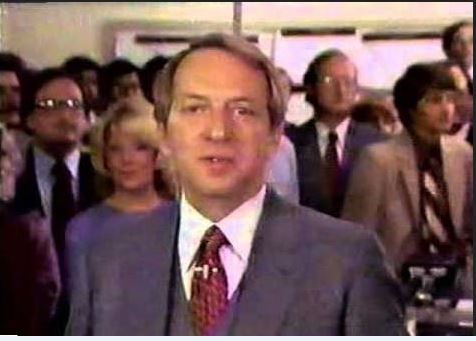
As they say …. “Time waits for no one”. May 2, 2026 will be the 44th anniversary of the launch of The Weather Channel Cable Network. Little did I know that while I was working for the U.S. Government in Washington, D.C. in the late 1970s, the weatherman for Good Morning America, John Coleman, had come up with an idea for a 24/7 national cable weather network and he spent years pitching that idea and assembling a team that would make a dream come to fruition. I also didn’t know that my career path and this idea turned reality would intersect.
On March 1st, 1982 a group of newly hired employees gathered together to begin orientation for a new company and we would spend the next two months getting ready to launch a network nationally.
Since I was in second grade (at Harvey E. Alter School in Rome, New York) I always wanted to be a meteorologist and now I was part of a revolutionary way for weather information to be communicated to the public. Here is my story … and I’m sticking to it !
Preface
During the 1970s, the public’s demand for more weather information increased dramatically. In the late 1970s John Coleman, who was a meteorologist for Good Morning America hatched a plan for a 24-hour cable network. After a long, an sometimes frustrating journey, the plan came to fruition. On May 2, 1982, The Weather Channel was launched and it became a key moment in the history of weather communication to the public. I was extremely fortunate to be a small part of it.
A Dream Comes To Fruition
John Coleman was a persistent man, he had to be in order to make a dream of his come true. As a meteorologist for Good Morning America, John realized that a brief weather report in the morning or other brief reports during 6 p.m. and 11 p.m. newscasts came up short of what the public expected and needed.
The National Weather Service was able to generate more information (e.g. tornado watches and warnings) but there was no good way to communicate it to the public. Often, a radio disc jockey would see a warning only after an event had occurred.
Television was in the midst of a great change as programs could be seen across the nation via satellite. All news networks like CNN were launched. John envisioned a national cable TV weather network in 1977. He tried to pitch his idea, in order to receive some backing, from the major TV networks first. he then approached other media outlets and cable conventions.
He often accomplished this by traveling long distances, in addition to his responsibilities at Good Morning America. The original name for his proposed network was Satellite Weather Service.
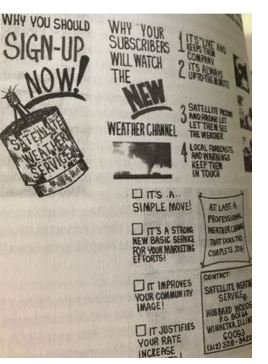
John Coleman’s pitch for a 24/7 cable network (Satellite Weather Service) to the cable TV world in the late 1970s. Credit-John Coleman/Weather Channel Pioneers book.
To make a long story short, there was rejection after rejection of his idea. In some of his rejections letters, there was a reference to “your weather channel”. Finally, Landmark Communications agreed to partner with John to launch and the name The Weather Channel was adopted. Landmark owned newspapers and other small publications, plus two local TV stations.
In addition to broadcasting national weather, and other features, 24 hours a day, it was impossible to persuade local cable TV affiliates to add The Weather Channel to their roster of cable stations without some kind of “localization”.
The Weather Channel development group, led by Alan Galumbeck, created the “Weather Star” Satellite Transponder Addressable Receiver that could capture and format NWS forecasts and automatically transmit them to a particular from a satellite to a receiver (Weather Star) that would be located at a particular cable TV location. Because of this, viewers would be able to receive their own local forecast. Weather instruments could also be sent to cable affiliates to indicate current conditions.
John’s weather support meteorologist was Joe D’Aleo who had been head of the Meteorology Department at Lyndon State College in Vermont. Joe became the first Director of Meteorology at The Weather Channel. John Coleman was the network’s first president.
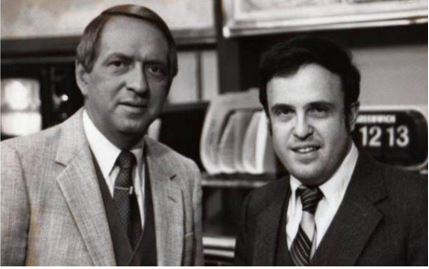
A photo of TWC President John Coleman (left) with the rst Director of Meteorology at The Weather Channel, Joe D’Aleo. Credit- Weather Channel Pioneers book.
Preparation For The Launch
In the summer of 1981, I was working for the government in Washington, D.C. My work involved some environmental testing but I wanted to switch to weather forecasting, which I always wanted to do since I was very young. I had also broadcast the weather at a local cable TV station in Upstate New York when I was a meteorology major in college.
One thing that I did was to subscribe to the American Meteorological Society Jobs Bulletin. I would receive the publication every month and it would contain various job openings around the nation. In October I saw that a 24/7 cable weather network was launching and they needed meteorologists.
To make this story short, I sent a resume and a letter practically begging to be hired. I had no idea what all of this meant but it was meteorology and TV.
In early January I received a call and a job offer. I moved to Atlanta and walked in the door, with the other original hires, to start work on March 1, 1982. For the next two months, we became acclimated to our jobs and kinks were worked out, while the on-air talent prepared for broadcasts by doing mock shows.
Finally, on May 2, 1982, the Weather Channel was launched during a national cable show in Las Vegas, Nevada. Many of the employees, including myself, were at The Weather Channel for the ceremony. There would be one-hour shows with two on-camera meteorologists around the clock with various weather segments (e,g, national radar). The original broadcast that evening featured Bruce Edwards and Andre Bernier.
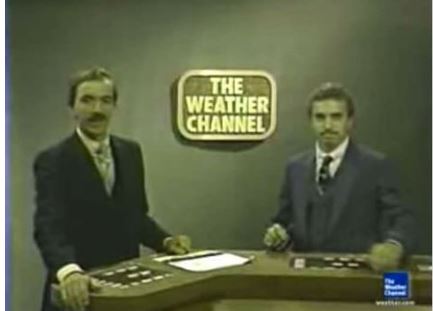
An image of Bruce Edwards (left) and Andre Bernier on the initial broadcast of The Weather Channel on May 2, 1982. Credit- TWC on YouTube.
Pundits and naysayers said that we wouldn’t last a year, but I guess we proved them wrong.
Information Explosion
I will skip over so many “early day” stories, but if you would like to know more there is a book that some of us original employees put together called “Weather Channel Pioneers“. I was thrilled to be able to contribute, in a small way, to this book.
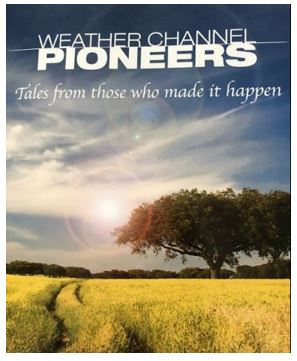 The Weather Pioneers book features the story of The Weather Channel origins and early days.
At long last, the public could get weather information ANY time of day. They could receive their local forecast several times an hour. One of the great features of the Weather Star was that all NWS weather warnings would crawl on your TV screes. For example in a tornado warning, your screen would turn red and the warning text would scroll. I’m sure that we saved countless lives with this “cutting edge” technology.
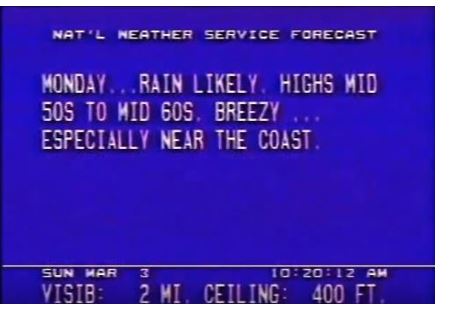 An image showing a local forecast and local information on the Weather Star (3000). Credit- TWC on YouTube.
The Weather Channel also made it a point to educate the public with various initiatives. In the early days it as one-minute vignettes such as the “Meteorological Minute”. Later, more sophisticated 1- hour presentations, featuring famous weather events, became commonplace.
In the early 1990s, TWC launched “The Weather Classroom” which was a series of 30-minute shows covering weather topics. The shows appeared overnight and teachers were encouraged to tape them on VCR’S. A textbook, that could be ordered, accompanied the shows. I was so happy to have been a part of the development of “The Weather Classroom.
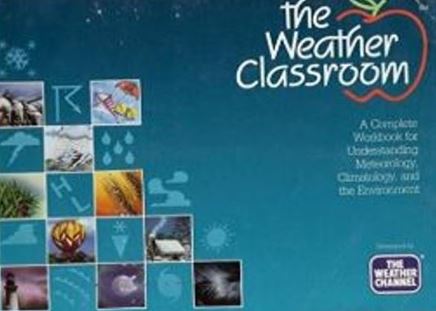
The Weather Classroom textbook which accompanied the 30-minute shows. Credit-Tom Moore.
Live On-Site Reports
Over the past several years, you can see hundreds of local and national media outlets covering a major weather event remotely from the field. I would have to say that The Weather Channel got the ball rolling with this.
In the early days, many of us suggested that we cover live weather events but it just wasn’t in the budget to do so. In fact, The Weather Channel came within an eyelash of being discontinued after a tumultuous second year when John Coleman was ousted and the network was bleeding money. It was an odd twist of fate that kept us alive, but once again I might tell that story at another time.
Eventually, The Weather Channel landed on more stable ground and we began to cover weather events in the field. I remember such a great job that was done by Dennis Smith and Cindy Preszler with their live reports during Hurricane Hugo around Charleston, South Carolina in 1989.
The Weather Channel expanded live coverage to other events like snowstorms and severe weather. Meteorologists like Jim Cantore and Mike Seidel became household names. Over time, other national networks and local TV stations followed suit and live reports accompany every major event across the board.
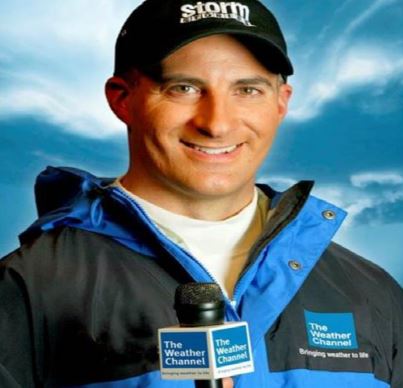
Photo of Jim Cantore who is a mainstay of live weather coverage and analysis on location for The Weather Channel. Photo Credit- Jim Cantore by permission.
Weather “Experts”
These days, “experts” on TV are commonplace. Actually, it’s not just for weather, you see them on news and business networks all the time. Our first “weather expert” was John Hope, often referred to as the “Hurricane Man”.
John served in the U.S. Army Air Corps as a meteorologist during World War II. Later, he was an advisor to NASA providing critical forecasts for their manned launches in the 1960s. John went on to be a senior hurricane specialist at the National Hurricane Center. He gave presentations around the world on tropical meteorology topics before being hired by The Weather Chanel as an On Camera Meteorologist/Hurricane Expert at startup.
I could write volumes about how much I liked and respected this man. John added instant credibility to the network with his calm “no-nonsense” approach to conveying critical weather information. He was once dubbed the “Walter Cronkite” of TV weather.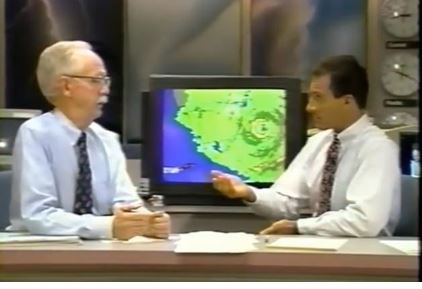
John Hope offers “expert” analysis with Jim Cantore on TWC during Hurricane Andrew. Credit-TWC on YouTube
After John Hope, Dr. Steve Lyons was the network tropical expert for the network. In more recent times, Dr. Rick Knabb took over those duties, Dr. Knabb had been the director of the National Hurricane Center.
Dr. Greg Forbes, a disciple of the great severe weather researcher Dr. Ted Fujita, has served as the severe weather expert. TWC even had a “climate expert” Dr. Heidi Cullen. Paul Kocin and then Tom Niziol have served as winter weather experts at the network.
In more recent times, the network still relies on experts and analysts during their broadcasts (e.g. Dr. Greg Postel and Carl Parker). As I mentioned earlier, other networks followed suit on what TWC started.
That’s A Wrap
Once again, I have taken on a subject where I am only able to scratch the surface. You get the idea, though, The Weather Channel ignited revolutionary changes in the way that weather is communicated to the public.
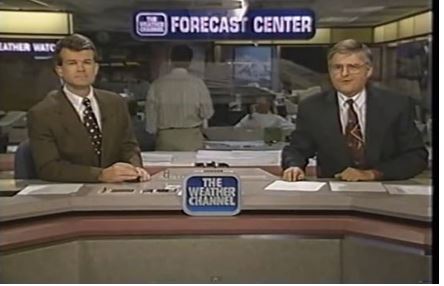
An image featuring your humble author Tom Moore (right) with Declan Cannon at The Weather Channel anchor desk in 1995. Credit-TWC on YouTube.
My career at TWC ranged from forecasting to consulting to broadcasting. I’m very fortunate to have been a Weather Channel “Pioneer” and for my 33+ years with the network. By the way, Rome New York, was in our original group of TWC affiliates and I often gave shout outs to Rome when I was on the air (especially on holidays)


