
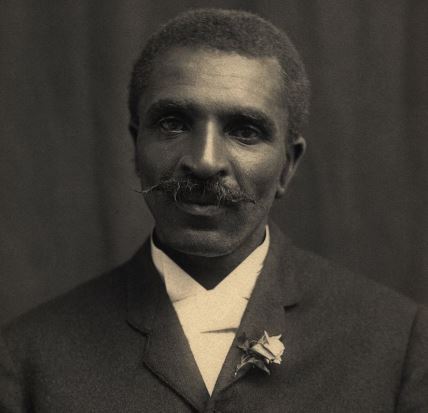
As you probably know, February is Black History Month. If you paid attention in your history class at school, you have probably heard of George Washington Carver. He could be described as an agricultural scientist and inventor and who promoted encouraged the growing of alternative crops to cotton and he developed methods to curtail soil depletion. His notoriety spread far beyond the black community and he is recognized as one of the most prominent scientists of his era. You might ask what does he has to do with weather? Actually, He does have a weather connection which I will highlight later.
I don’t usually get off the beaten path with just weather history, but George Washington Carver’s story is compelling. He overcame many obstacles to achieve his status. His curiosity and tenacity helped him to reach the notoriety that defined him.
A Path To Prominence
George Washington Carver was born into slavery before the end of the Civil War (most likely in 1864). Because of the Missouri Compromise the Missouri Compromise in 1820, Missouri was entered into the U.S. as a slave state while Maine came in as a free state. Carver’s father died soon after his birth. George, his mother and sister were kidnapped but George’s slave owner, Moses Carver, negotiated a deal to take George back. Moses Carver and his wife Susan raised George and his older brother as their own. Susan taught the curious George how to read and write and encouraged him to keep learning.
Because of his race, George was not allowed to attend public school so he enrolled in a school for black children which was in a town ten miles away from home. When he got to the town he found the school closed for the night. He slept in a nearby barn.
The next morning, he met Mariah Watkins, from whom he wished to rent a room. When he identified himself as “Carver’s George”, as he had done his whole life, she replied that from now on his name was “George Carver. Mariah said to George “You must learn all you can, then go back out into the world and give your learning back to the people,”
When George was 13 he enrolled in an academy in Fort Scott, Kansas. He went on to other schools before graduating from Minneapolis High School in Kansas. George was accepted at Highland University but he was banned from attending because of his race.
He homesteaded land near Beeler, Kansas, where he maintained a small conservatory of plants and flowers and a geological collection. Incredibly, He manually plowed 17 acres of the claim, planting rice, corn, Indian corn and garden produce, as well as various fruit trees, forest trees, and shrubbery. He also earned money by odd jobs in town and he worked on a ranch. When he was n his middle 20s, George studied art and piano at Simpson College in Iowa. His art teacher, Etta Budd, recognized Carver’s talent for painting flowers and plants and encouraged him to study botany at Iowa State Agricultural College, which is now Iowa State University.
George was the first black student at Iowa State. His bachelor’s thesis for a degree in Agriculture was “Plants as Modified by Man”, dated 1894. Iowa State University professors convinced Carver to continue there for his master’s degree. Carver did research at the Iowa Agricultural and Home Economics Experiment Station over the next two years. His work at the experiment station in plant pathology and mycology first gained him national recognition and respect as a botanist. Carver received his MS degree in 1896 Carver was the first African American faculty member at Iowa State. Although he never attained a doctorate degree, he was awarded a number of honorary doctorates over the years.
Tuskegee Years
In 1896, Booker T. Washington, who was the first principal and president of the Tuskegee Institute now Tuskegee University), invited Carver to head its Agriculture Department. Carver taught there for 47 years, developing the department into a strong research center and working with two additional college presidents during his tenure. He taught methods of crop rotation, introduced several alternative cash crops for farmers that would also improve the soil of areas heavily cultivated in cotton, initiated research into crop products, and taught generations of black students farming techniques for self-sufficiency.
In the years that followed, Booker T. Washington gave George several administrative tasks. He was wasn’t very successful in that realm, however. Starting in 1815, Carver concentrated on researching and experimenting with new uses for peanuts, sweet potatoes, soybeans, pecans, and other crops, and having his assistants research and compile existing uses. This work, and especially his speaking to a national conference of the Peanut Growers Association in 1920 and in testimony before Congress in 1921 to support passage of a tariff on imported peanuts, brought him wide publicity and increasing renown. In these years, he became one of the most well-known African Americans of his time and was often known as the “Peanut Man”.
Carver developed techniques to improve soils depleted by repeated plantings of cotton. Together with other agricultural experts, he urged farmers to restore nitrogen to their soils by practicing crop rotation.
Following the crop rotation practice resulted in improved cotton yields and gave farmers alternative cash crops. He also trained farmers to successfully rotate and cultivate new crops, Carver developed an agricultural extension program for Alabama that was similar to the one at Iowa State. To encourage better nutrition in the South, he widely distributed recipes using the alternative crops.
He founded an industrial research laboratory, where he and assistants worked to popularize the new crops by developing hundreds of applications for them. They did original research as well as promoting applications and recipes, which they collected from others. Carver distributed his information as agricultural bulletins.

George Washington Carver in his lab at Tuskegee Institute … USDA History Collection, Special Collections, National Agricultural Library.
Rise To Fame
In 1916, Carver was made a member of the Royal Society Of Arts in England, one of only a select few of Americans at that time to receive this honor.
The Fordney-McCumber Tariff was enacted in 1922, which included a duty on imported peanuts to protect American farmers being undermined by cheap Chinese imports was based on Carver’s testimony before Congress where he presented included samples of peanut milk, peanut flour, industrial dyes made from peanuts, and other peanut-based products. This helped Carver rise to prominence on a national scale.
In the 1920s an 1930s, George published articles in peanut industry journals and wrote a syndicated newspaper column, “Professor Carver’s Advice”. Business leaders came to seek his help, and he often responded with free advice. Three American presidents— Theodore Roosevelt, Calvin Coolidge and Franklin D. Roosevelt met with him. From 1923 to 1933, Carver toured white Southern colleges for the Commission On Interracial Cooperation.
Carver’s Connection To Weather
In addition to his numerous contributions to the science of botany and to modern agriculture in general, George was also extremely interested in weather. From 1899 to 1932, Carver served as a voluntary weather observer as part of the U.S. Weather Bureau’s Cooperative Observer Program. He recorded weather observations for Tuskegee, Alabama during his tenure as agricultural director for the Tuskegee Institute.
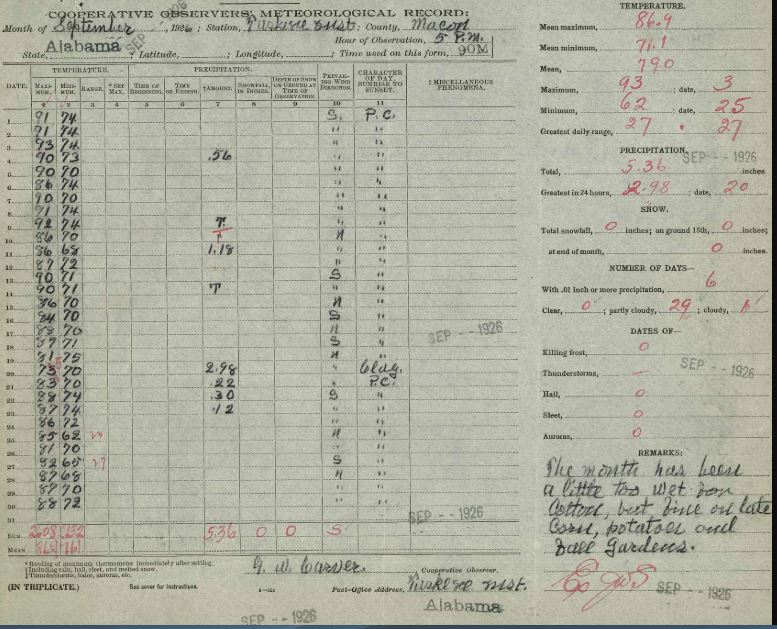
In September 1926, a strong hurricane blew through Florida, Alabama, and Mississippi. Carver’s weather log shows almost 3 inches of rainfall on September 20 as the hurricane passed through the area. He noted that, “The month has been a little too wet for cotton, but fine on late corn, potatoes, and fall gardens.”
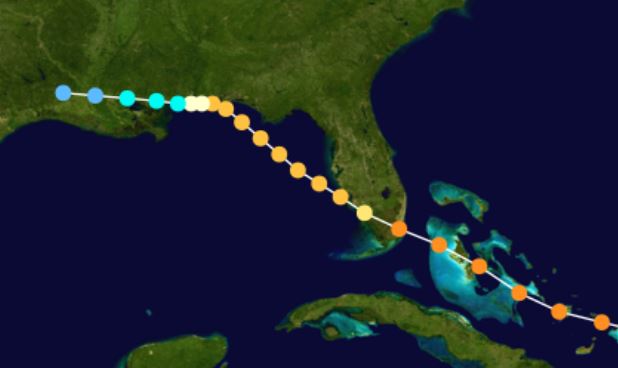
A track map of Hurricane Seven of the 1926 hurricane season (September) showing a hurricane than impacted the Deep South/Gulf Coast region. Image Credit – Wikipedia/NOAA- Public Domain.
The Cooperative Observer Program was formally created in 1890 and it continues today, with NOAA’s National Weather Service. You can find Carver’s weather logs at the NOAA Central Library (https://library.noaa.gov/home) and they are available to download on their website.
Carver understood the role that weather played in agriculture. Rainfall patterns, temperature swings, and soil moisture determined whether a farm thrived, survived, or didn’t make it. Treating crops without understanding climate, he believed, was like treating symptoms without diagnosing the disease. The contributions Carver made to the environmental movement, including his ahead-of-the-times ideas about self-sufficiency and sustainability, were far more important than the peanut work in the long run.
A long time ago, I went on day trip which included a stop in Tuskegee, Alabama. I encourage you all to visit if you get a chance. https://www.nps.gov/tuin/index.htm. You can take a tour of Tuskegee Institute National Historic Site, the history of which is very interesting .
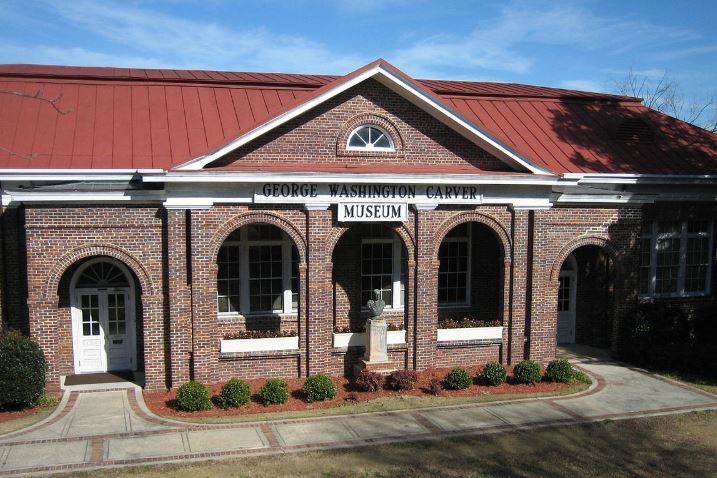
George Washington Carver Museum in Tuskegee, Alabama. Credit – NPS.
The George Washington Carver Museum, located on the campus and is managed by the US National Park Service with self-guided tours. The Carver Museum has several exhibits, including crop rotation theories that helped the Southern United States economy boom, and learn the history of George Washington Carver himself.


