
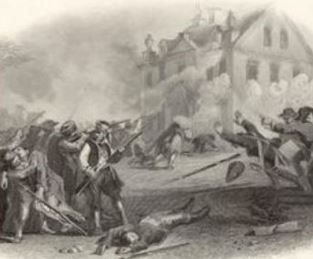
In one of the many Revolutionary War battles that were fought around Philadelphia, General George Washington’s forces took on the British at Germantown, Pennsylvania, on October 4, 1777. A thick fog, rolled in and it was a significant factor in the outcome.
Prelude To Battle
In a series of battles in 1777, the British took the upper hand with victories in the Philadelphia area. This allowed General Howe to take over Philadelphia, which was the capital of the colonies. This was the first, and only time, that our capital city has ever been taken over by a foreign power,
After taking over Philadelphia, General Howe kept around 3,000 troops in the city but he sent over 8,000 to Germantown, which was just to the north.
General George Washington, seeing what Howe did, thought that if he could take on the British troops at Germantown, and perhaps deliver a surprise knockout punch it could change the tide of the war. The attack would take place overnight, similar to what occurred in his earlier victory at Trenton.
Washington developed a rather complex plan which would involve four separate columns to converge on Germantown. Two flanking columns were composed of 3,000 militia while the center-left under Nathanial Greene, the center-right under John Sullivan, and the reserve under Lord Sterling were made up of regular troops.
The Battle Of Germantown
On the evening of October 3rd, the Continental Army began a 16-mile march toward Germantown with a force of 11,000 men. Washington’s soldiers were told to put a piece of white paper in their hats so they could tell the difference between friend and foe.
In an article in sandcastles.net the military journal of Lt. George Ewing, who fought in the Battle of Germantown was published. Here is his entry on page 23.
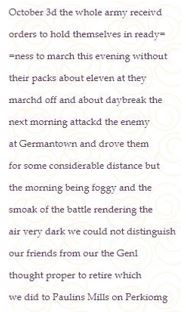
In the darkness, the troops didn’t make the progress that was expected. As dawn approached on the cool morning of October 4th, a dense fog began to roll in.
One of the four attacking columns of soldiers held back and started a fire in an attempt to deceive the British. The other three marched down various roads into town.
General Washington, unaware of the overall confusion and lack of communication in the fog, kept on the attack and was beaten back by British and Hessian troops. Washington finally ordered a retreat. General Howe ordered pursuit and that chased the Americas for 9 miles before calling the chase off as darkness approached.
If you read enough about the Revolutionary War, you will notice that not following up on battle victories and letting the Americans get away to fight another day was common for the British, and General Howe in particular.
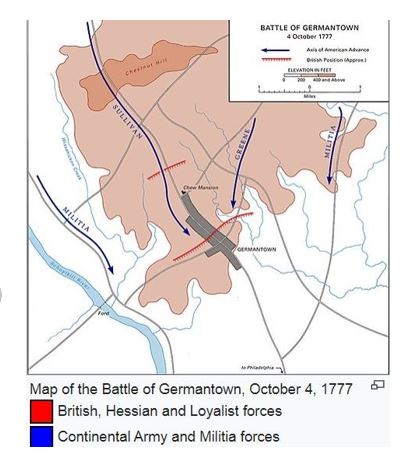
A map of the Battle of Germantown on October 4, 1777. Map Credit-Wikipedia-Public Domain.
Aftermath
Of Washington’s total army of 11,000, 152 were killed and 527 were wounded and 438 were captured. On the British side, 71 were killed, 448 were wounded and 14 were missing.
After review, a combination of factors was blamed for the American’s defeat. Washington resigned himself to the fact that his troops were too inexperienced and poorly trained to execute a complex plan. The fog mixing with smoke (from the fires) was also a contributing factor that led to mass confusion and Americans firing on their own soldiers. General Stephen’s poor decision-making was also an issue. It was later determined that he was intoxicated and was later court-martialed and released from the military.
A Silver Lining
All was not lost, however, many Europeans, especially the French, were impressed by the American’s tenacity against the British. Comte de Vergennes, a high-level French diplomat who had enormous influence within the French government was impressed by the Continental Army at Battle of Germantown despite the defeat.
The French decided to heavily support the Americans. This included naval power to thwart the movement of British ships along the coasts. This took away a major advantage that the British had enjoyed. French military advisors, such as Lafayette helped with the training of soldiers bringing higher professional standards to field commands.
Today, a historical marker denotes the Battle of Germantown.
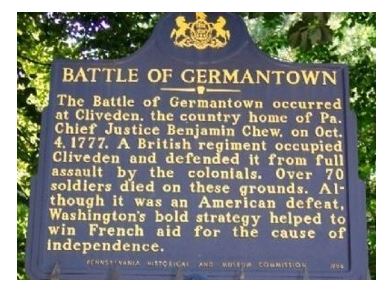
A photo of a historical marker denoting the Battle of Germantown on October 4, 1777. Photo Credit-William Fischer Jr.- hmdb.com.


