

Introduction
While watching weather segments on my local Atlanta news over the past week, I kept seeing the record high temperature most days from 1925. So, I decided to do a little research back 100 years to September of 1925 to see how extensive the heat was and if it was over a larger area.
It’s fun to go back 100 years ago and I could write an article about that because it was a fascinating time. The first radio broadcast of a U.S. President (Calvin Coolidge) took place. There was the famous Scopes Monkey Trial and the publication of F. Scott Fitzgerald’s The Great Gatsby. My parents were both alive in 1925, although my mother was only a one year old. You can see why it is so easy to get off track so I’ll get to the weather connection.
The 1920s featured fun and prosperity, at least to parts of the nation. Industry was booming, as evidenced by the robust auto industry in cities like Detroit. It was a vastly different situation the South were agriculture still ruled. Any excessive rainfall, lack of rainfall or extremely high or low temperature could impact the economy substantially.
To make matters worse, a devastating pest , boll weevil, damaged the cotton crop to a great degree.
A Heat Wave For The Ages
The summer of 1925 featured numerous hot spells across the southern U.S. and the heat expanded up into the Midwest at times. Rainfall was scarce and the soil moisture was low. In a recently published in the Journal of Applied Meteorology and Climatology researchers examined the influence of drought on heat wave intensity, duration, and human exposure to extreme heat. Dry soils reduce local evapotranspiration (ET) rates, but this study also found that the soils retained more heat. The combination of reduced ET and warmer soils likely allowed heat to escape into the atmosphere, driving warmer air temperatures. Basically, solar radiation was being absorbed directly by the Earth rather than by atmospheric moisture. The process feeds on itself. With less evaporative cooling from the surface, more of the sun’s energy is used to heat the ground and the air directly above it. Dry soil is also more efficient at radiating heat back into the atmosphere. Weather systems moving into a region with a dry, warm atmospheric layer lose much of their moisture before it can fall as rain. The dry air can erase incoming moisture, reinforcing the dryness of the air and making it less likely for rainfall to occur.
The summer heat extended into September, especially across the South and it was relentless ! State high temperature records were established in Alabama, Mississippi, Tennessee, Georgia, Arkansas and South Carolina.
In Alabama, an all-time high temperature record was set at Centerville on September 5th as the mercury hit 112 degrees. Every weather reporting station in the state recorded temperatures over 100 degrees on that date. On the same date, Clarksville, Tennessee reached 112 degrees. Americus, Georgia recorded 111 degrees on September 6gh.September 7th, the all-time temperature record was set at Pontotoc, Mississippi, with 111 degrees.

Reports on the overwhelming heat wave were featured in the Nashville Tennessean Newspaper in September of 1925. Image Credit-Tennessee State Library and Archive.
The warmest temperatures ever recorded during the month of September occurred at Hattiesburg, Mississippi (103°), Jackson, Mississippi (107°), and Mobile, Alabama (103°), and Pensacola (102°). A brief cooler spell started in the second week of September but the intense heat returned from September 14 to 23, setting more daily temperature records.
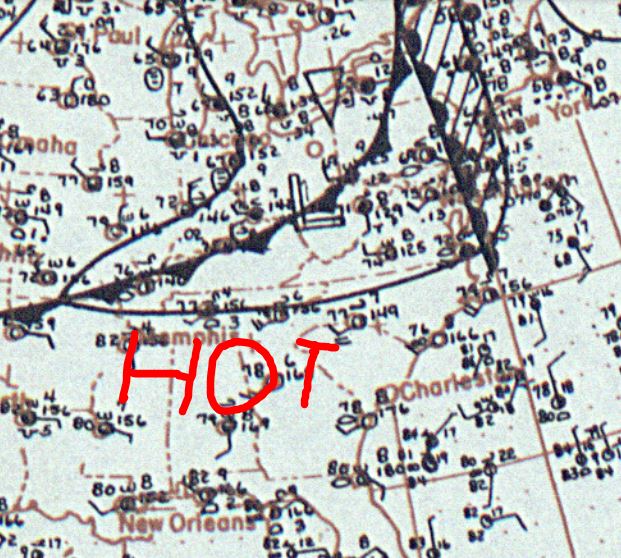
A surface weather map from the morning of September 7, 1925 showing most of the southern U.S. in a warm sector between and warm front and a cold front. Image Credit – Daily Weather Maps/NOAA.
The heat was so severe that it caused intense conditions, with the wind added, some people had scorched faces. A death toll from this event was never published but estimates ranged in the hundreds !


