

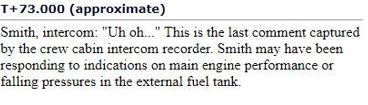
“Uh Oh”, uttered by Pilot Michael J. Smith, was the last communication from the Space Shuttle Challenger at seventy-three seconds into the mission on the frigid morning of January 28, 1986. In an extremely short period of time, Challenger broke apart and the cabin plunged quickly into the Atlantic Ocean below killing the entire crew.
The disaster was the first one in American History to take place on live television. There was a special interest in this mission since the seven-person crew included Christa McAuliffe who was the first teacher and regular citizen to be launched into space. Schoolchildren from around the nation witnessed this tragic event.
Background
The Space Shuttle was designed to be a partially reusable orbiting spacecraft. The Space Shuttle program was a follow-up of the Apollo program although the first space shuttle (Columbia) was launched on April 12, 1981, nearly a decade after the final Apollo mission.
I visited Florida in 1979 and took a tour of the Kennedy Space Center. For part of the tour, we were on a bus and the driver pointed out the Columbia, which was all viewed from a distance. We were told that the craft would be the first space shuttle launched. There were five original space shuttles built but only four of them were deemed space worthy.
All told, there were three hundred and fifty-five space shuttle missions from 1981 until 2011 when the program ended.
Developers and engineers involved with the Space Shuttle Program were well aware of some potential flaws in the design and functionality of the craft. The space shuttles had two solid rocket boosters with seven sections. Six of the seven were joined in pairs at the factory. The other segments were put together at the Kennedy Space Center with three joints. The joints were sealed with asbestos-silica insulation applied over the joint, while each joint was sealed with two rubber O-rings.
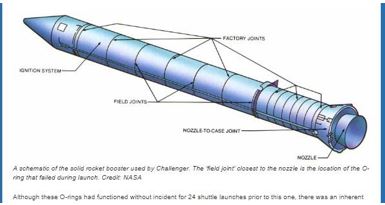
The O-rings were a constant concern during the whole construction process. There could be no safe abort of a mission if burn through by hot gases of the rocket’s casing occurred.
The O-ring joints were supposed to close more tightly due to forces generated at ignition, but tests showed that when pressurized water was used to simulate the effects of booster combustion, the metal parts bent away from each other, opening a gap through which gases could leak.
This is referred to as “joint rotation”. When this occurs combustion gases could erode the O-rings. If the erosion was great enough it could cause the joint to burst which would destroy the booster and the shuttle.
From 1981 through 1985, seven of the nine shuttle flights displayed considerable O-ring erosion. Two of the flights came close to disaster. NASA decided that this was an acceptable flight risk and they continued the missions rather than going through a redesign of the rocket booster system.
There were also concerns about the effect of low temperatures and wind on the resilience of the O-rings. In my early days at The Weather Channel, we would provide meteorological information to the Kennedy Space Center for their shuttle launches. For example, If the temperature was going to be excessively cold and the winds aloft were greater than the accepted parameters, we would let them know and the mission would have to be postponed.
A warm O-ring that has been compressed will return to its original shape much more quickly than a cold O-ring. Research has shown that an O-ring at 75 degrees Fahrenheit is five times more responsive in returning to its uncompressed shape than a cold O-ring at 30 degrees Fahrenheit. So, very low temperatures could lead to a failure of the O-ring to do its job and there would be a higher chance for a catastrophic failure.
By the time the Challenger was launched The Weather Channel was no longer providing information for the missions. From what I understand, wind shear became more of an issue than actual winds as time went on but as I will show you later, temperatures were very cold, winds aloft were unusually strong for that latitude and there was considerable wind shear for the Challenger launch.
As January 1986 came around the Space Shuttle Challenger was being prepared for launch. The initial launch date was January 22nd but that was postponed until the next day and then there was another delay to the 24th. On January 25th, there was bad weather at the abort landing site in Dakar, Senegal.
The launch then was delayed to January 27th due to bad weather at the launch site. On January 27th there was another delay due to a bad hatch on the orbiter. With all of the delays and because there was all of the hype about the first teacher in space, NASA made the decision to launch on January 28th.
Meteorological Conditions
Although clear skies were predicted on January 28th, temperatures were extremely cold along the “Space Coast” of Florida. The northern polar jet stream had taken a big dive down the Eastern Seaboard and winds aloft were quite high, even down to Florida. A nearby subtropical jet stream created wind shear. Many engineers were wary of any launch when the temperature was below 40 degrees.
Below is a surface weather map from 7 AM. An arctic high-pressure system was moving into Florida. The associated cold front has swept southward past Cuba. Surface temperatures in central Florida had dropped down to the low to mid-20s.
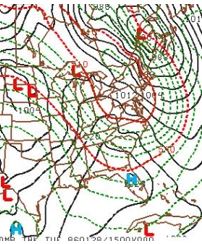 A surface weather map from 7 AM on January 28, 1986, showed an arctic high-pressure system across the Southeast, including Florida, Map Credit-NWS
As for, the launch area, the early morning temperature at nearby Merritt Island was 25 degrees. The image below is an atmospheric sounding (profile showing temperatures in Celcius) and wind speed and direction. The temperature (red color) indicated well below-freezing conditions. A strong polar jet stream has swept down into Florida, not too far north of the Cape! The wind barbs are on the right side and it indicates that wind speeds at the jet stream level were up around 100 mph (200-300 millibar area). There is also a turning of the winds with height (wind shear). stream
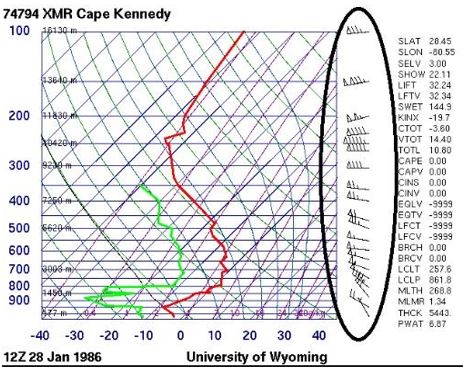
A sounding (atmospheric profile) at The Kennedy Space Center in Florida, shows freezing temperature (in Celcius) and strong winds plus strong wind shear. Image Credit-PSU.
There had been no other shuttle mission launched in conditions anywhere near what occurred that morning. The previous low temperature for the launch of a space shuttle was 54 degrees. By the time the Challenger was launched at 11:38 a.m. EST, the temperature had risen to 36 degrees.
By early morning, ice was all over the launch pad and there was much concern that the shuttle could be damaged. There was a large temperature difference between the solid rocket boosters because one was exposed to sunlight and the other was in the shade.
There was also concern that ice could break off and hit the thermal protection tiles upon liftoff. These tiles were another major design flaw of the space shuttles and that issue would come into play in 2003 when the space shuttle (Columbia) was lost. It burned up during reentry in 2003 resulting in another seven fatalities.
Gone In Just Over A Minute
The decision had been made and this ” historic” mission with the first teacher to travel into space would take place on this cold Tuesday morning. A crew of seven consisted of Commander Dick Scobee, Pilot Michael J. Smith, Ronald McNair, Ellison Onizuka, Gregory Jarvis, Judith Resnick, and the teacher Crista McAuliffe.
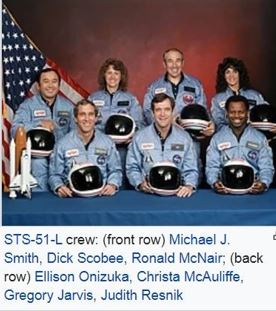 A photo of the Challenger crew. Photo Credit NASA
All was set for liftoff at 11:38 a.m. EST. The countdown was complete, and Challenger lifted off. Unfortunately, this event would come to a shockingly tragic end in a hurry.
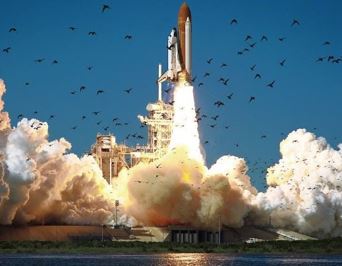
The photo shows the liftoff of the Space Shuttle Challenger on Tuesday, January 28, 1986, at 11 38 a.m. EST. Photo Credit- NASA
The initial fears of some engineers came true. A massive leak in the external liquid hydrogen tank initiated the eventual breakup of the Challenger within seconds.
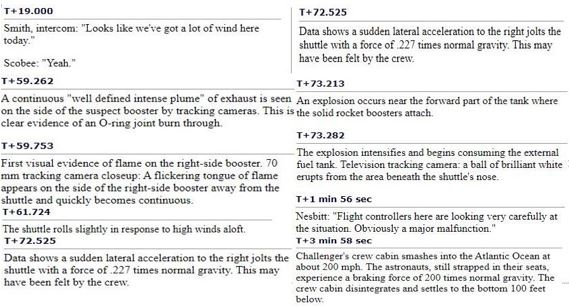
I have pieced together some critical points from the launch to the time when the cabin falls from the sky and crashes into the Atlantic. All of that occurred in less than four minutes.
The Challenger made adjustments to compensate for the significant wind shear during that time. The effect of the wind The temperature probably compromised the functionality of the O-rings.
Here is a timeline of the mission over a nearly four-minute period.
The final communication from Challenger was the phrase uttered by Pilot Michael J. Smith seventy-three seconds into the mission.
Those who were present for the launch, including Christa McAuliffe’s mother and others across the nation and around the world who watched the telecast (including school children) were horrified.
The nation was stunned and saddened. The United States had been launching astronauts into space for nearly 25 years and this is the first time that we lost any of them during a mission.
Epilogue
One out of every six Americans watched the launch on live television mainly because of Christa McAuliffe going into space. One study indicated that around 85 percent of Americans had heard the news of the disaster within an hour.
I had the day off from The Weather Channel but I didn’t watch the launch on TV. I was at work the day before for an On-Camera shift. We weren’t providing weather information for the space shuttle launches anymore but I tended to check the weather before launches as a matter of course.
I checked the forecast conditions and saw the forecast temperature. I also looked at the upper-level wind charts and I saw how strong the winds were (significantly higher than what was acceptable when we were involved). I just assumed that the mission would be delayed again so the next morning so I went to a lecture at a local college.
I came out of the event before noon and was walking to my car. A man was passing me by and asked if I had heard about the Challenger. I was shocked by the news! Before the emotion of it all hit me my initial thought was (I can’t believe that they launched it)!
President Ronald Reagan was supposed to deliver the State of the Union Address on the night of the Challenger disaster. That was postponed and it was decided that he would address the nation about the disaster from the Oval Office. In a very moving speech, President Reagan said the following :
“We will never forget them, nor the last time we saw them, this morning, as they prepared for their journey and waved goodbye and slipped the surly bonds of Earth to touch the face of God.”

The image shows President Ronald Reagan addressing the nation following the Challenger disaster on the evening of January 28, 1986. Image Credit-YouTube.com
Search and recovery operations took place in the first week after the Challenger disaster. The operation was managed by the Department of Defense for NASA with the assistance of the U.S. Coast Guard.
The twisted remains of the cabin were discovered in the ocean on March 7th. The cabin and remains of the crew were subsequently recovered. Later in the month, a couple of pieces from the Challenger washed up on the shore at Cocoa Beach, Florida.
A Presidential Commission on the Space Shuttle Challenger Accident, also known as the Rogers Commission after its chairman, was formed to investigate the disaster.
It found that the Challenger accident was caused by a failure in the O-rings sealing a joint on the right solid rocket booster, which allowed pressurized hot gases to “blow by” the O-ring and make contact with the adjacent external tank, causing structural failure. The failure of the O-rings was attributed to a faulty design, whose performance could be too easily compromised by factors including the low temperature on the day of launch. (Rogers Commission (June 6, 1986). “Chapter IV: The Cause of the Accident”. Report of the Presidential Commission on the Space Shuttle Challenger Accident).
In response to the commission’s recommendation, NASA initiated a total redesign of the space shuttle’s solid rocket boosters, which was watched over by an independent oversight group as stipulated by the commission.
After the disaster, NASA’s Space Shuttle fleet was grounded for almost three years while the investigation, hearings, engineering redesign of the SRBs, and other behind-the-scenes technical and management reviews, changes, and preparations were taking place.
A new shuttle (Endeavor) replaced the Challenger in the launch rotation.
At 11:37 a.m. on September 29, 1988, Space Shuttle Discovery lifted off with five veteran astronauts.
Many years later, an engineer involved with the Space Shuttle program came to visit us at The Weather Channel. A few of us were gathered in a room and we casually asked him some questions. He told us that the shuttle missions were “hold your breath” because the chance of a catastrophic failure was not insignificant.