


As of this writing, Atlanta and much of the North Georgia area, is bracing for a significant ice storm over the coming weekend. There are many residents of this region that can remember a crippling ice storm that struck Atlanta and the North Georgia area on January 7, 1973. I remember in the my early days of The Weather Channel of coworkers talking about it. It was less than ten years after this event when we launched our operation. The storm led to road and business closures major transportation disruptions and least 300,000 customers without power.
One meteorologist that I worked with for many years at The Weather Channel, Guy Walton, lived near Augusta, Georgia, and recalled the event.
“I remember as an 11 year old boy in Tignall GA being out of school for a week with no electricity for several days. I helped my dad keep the house warm by keeping our fireplace going … thankfully we had many quilts made by my grandmother to keep us warm while sleeping.” He went on to say – “Walking outside I saw everything covered in at least 3/4 inch of ice with many broken trees.”
Meteorological Conditions
On January 7th a strong arctic high in Canada sent plenty of cold air southeastward into the U.S. The arctic air made it down to the Atlanta area but it was shallow. Meanwhile, to the south, waves of low pressure rode along a stationary front. Warmer air moved aloft over the shallow cold air at the surface. Surface temperatures were below freezing as light rain and sleet began to fall in the early morning to the west and northwest of Atlanta. By afternoon the precipitation was falling as a mixture of sleet and freezing rain. By the end of the day the entire northern third of Georgia was affected. The storm continues overnight and into the next day! Metro Atlanta was the hardest it. by the ice storm. Extreme northern and eastern counties had mainly snow and sleet and were less affected by ice. This left the area encased in five to six inches of sleet and ice.
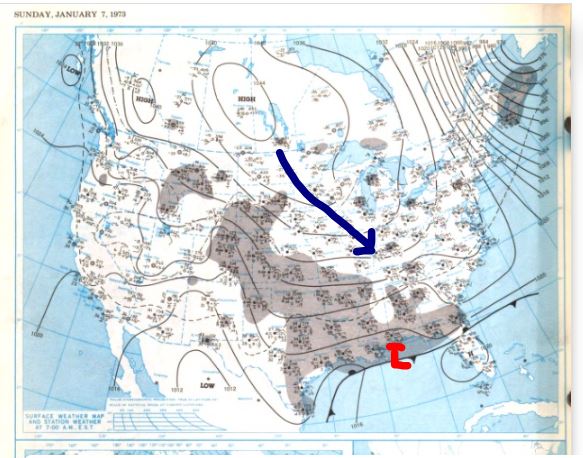
A surface weather map from January 7th, 1973 showing an arctic high and a wave of low pressure along a stationary boundary that produced an ice storm for Atlanta, Georgia. Map Credit-NOAA
Impacts
This was Georgia’s worst ice storm since 1935 and the most destructive. In response to the storm, Georgia Air National Guard C-124 Globemasters of the 165th Military Airlift Group airlifted truck and trailer-mounted generators to Dobbins Air Force Reserve Base in Marietta to provide emergency back-up power. Generators were also provided by the Saint Simon’s Island-based 224th Mobile Communications Squadron while the 129th Tactical Control Squadron of Kennesaw provided two large power plants. Through a joint effort between the Georgia Guard and the State Civil Defense, 27 generators were supplied to provide power to critical locations within the Atlanta area.
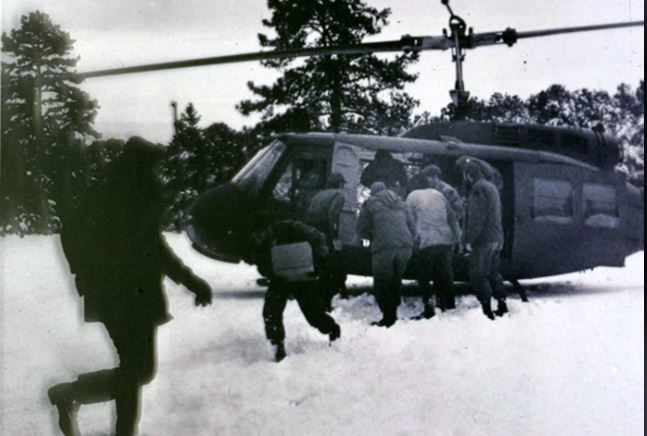
A photo from January 1973 showing the Georgia National Guard delivering supplies to Dobbins Air Force Reserve Base near Atlanta, Georgia by helicopter. Photo Credit-Georgia National Guard.
There are pine trees galore in the Atlanta area. The weight of the ice damage branches and tree trunks and resident hears constant cracking sounds as branches broken. The city was basically shut down for an entire week. The Atlanta Journal reported that DeKalb County police estimated 90% of residents were without power. Police and fire departments were inundated with calls about fallen trees, fallen power lines, and power outages.
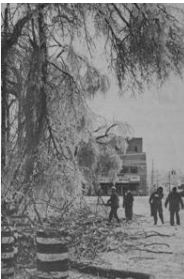
An image of a road crew clearing tree debris from a road in Cobb County, Georgia in January 1973. Image Credit-Facebook-Public Doman.
Total storm damage was estimated to be well over 25 million dollars (nearly 180 million in 2026). Extreme cold lasted well into the following week which made restoring services even more difficult. All of this created a rush on camping equipment, candles, portable stoves and other emergency supplies, and there were reports of price gouging, but that was minor. Telephone service was also cut off for several days. Many schools were also shut down through the following week. An elderly couple died in a house fire. Some residents didn’t get power restored until two weeks later !
Today, the Atlanta Metro has about five times the population as compared to 1973. Hopefully, residents will be as prepared as they can for whatever occurs.