
Introduction
Our nation’s Southwest is mainly a desert but there tines when heavy rain and flooding occurs. As I writ this, there is significant flooding in the Southwest with roads being washed away, along with water rescues.
Most of the rain that falls in this region comes from moisture from eastern Pacific cyclones being pulled northward and northeastward by an upper-level trough to the north or during the annual summer monsoon that usually occurs from July to September. The current situation is a combination of tropical moisture from a disturbance within a monsoonal pattern. It’s unusual to see the summer monsoon extend this far into September, by the way.
The U.S. East Coast and Gulf Coast aren’t the only areas that have to deal with tropical cyclones. There are plenty of tropical storms and hurricanes that form in the eastern Pacific. Impacts of these systems can make it up to the southwestern U.S. An extreme example occurred in late September and early October of 1983 when abundant moisture from Tropical Storm Octave flowed into the Southwest resulting in massive flooding with over a dozen fatalities.
Tropical Storm Octave – September 1983
Tropical Storm Octave developed from an area of disturbed weather in the eastern Pacific on September 23, 1983. The disturbance moved west for four days before becoming a tropical depression on September 27th off the southwest coast of Mexico. After that, it strengthened to a tropical storm (Octave) with maximum sustained winds of 50 mph. Some wind shear kept Octave from growing stronger.
By September 30th, Octave began to move quickly to the northeast, as it weakened to a tropical depression over cooler waters and it finally dissipated three days later.
Although the system itself never made it to the U.S. its deep tropical moisture did. Octave’s moisture was funneled northeastward into southeast Arizona and parts of New Mexico and it hung around for days.
Octave’s Impacts
Rain moved into Arizona on September 28th. Rainfall for the year was already well above average resulting from a wet winter season followed by an active summer monsoon. The state really couldn’t handle much more rain, but a whole lot more rain inundated the area anyway.
On September 29th. Heavy rain and strong thunderstorms swept across southeast Arizona. After a break on the 30th, more heavy rain developed midnight on October 1st and it continued through much of the morning hours.
More heavy rain moved across southeast Arizona in the early morning hours of October 2nd, which sent most river gauges along the Santa Cruz, Rillito, and Gila Rivers to their highest crests on record.
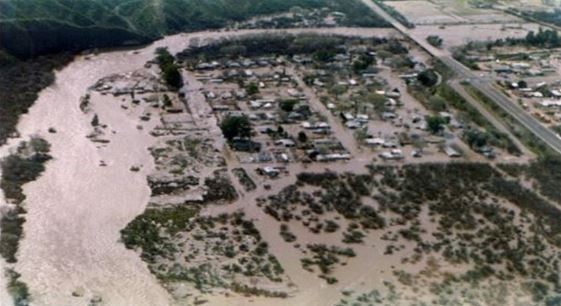
The highest rainfall total from Octave was twelve inches at Mt. Graham. In Tucson, flood waters reportedly reached 8 feet stranding hundreds of people on rooftops picked up from five to eight inches and major damage resulting from the heavy rain and flooding . Almost every low water crossing in Tucson flooded as police and fire departments were overwhelmed with calls for help.
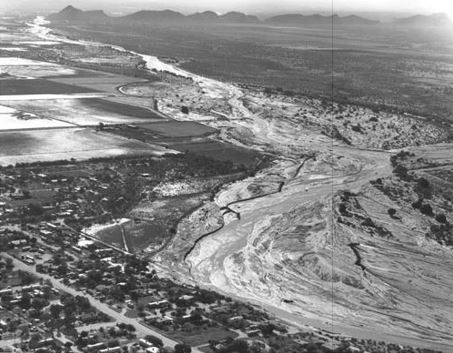
A photo of Tucson, Arizona, shows widespread flood damage triggered by Tropical Storm Octave on October 2, 1983. Credit -www.geoarizona.edu.
Throughout the state, excessive rainfall caused many rivers to overflow. Water was released from the Coolidge Dam, which forced 75 residents to evacuate, marking the third time in 50 years that water was released from the dam. After a third round of heavy rain on October 2, the Santa Cruz Rillito, and Gila rivers experienced their highest crests on record.
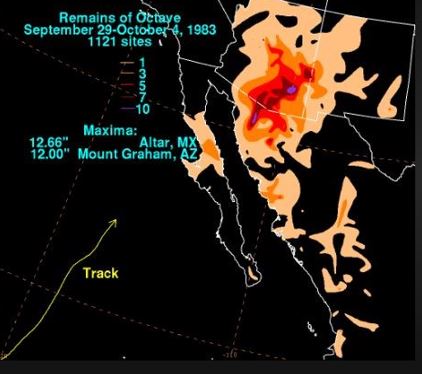
This map shows rainfall totals up to one foot over parts of Arizona from Tropical Storm Octave in 1983. Credit- NOAA.
The deluge of rain caused many rivers to over flow across Arizona. The towns of Clifton, Duncan, Winkelman Hayden, and Marana suffered catastrophic flood damage.
In Marana, many homes were submerged, forcing residents to be evacuated. Over 700 homes were destroyed in Clifton and about three-quarters of the businesses were destroyed. Over eight hundred houses, mobile homes, and apartments were destroyed while over two thousand others were damaged.
About ten thousand people were temporarily left homeless. Damage in Arizona totaled around 1 billion dollars (over 3 billion 2026 dollars). Fourteen people drowned and nine hundred and seventy- five were injured.
President Ronald Reagan declared Cochise, Graham, Greenlee, Pima, Santa Cruz, and Yavapai counties a “major disaster area”.
Next door in New Mexico Mexico Octave was responsible for around 25 million (86 million 2026 dollars) in damage in New Mexico. Governor Bruce Babbitt declared a major emergency.
Meteorological Factors
Eastern Pacific tropical systems that often turn to the west of northwest (away from Mexico) early in the season sometimes turn to the north and northeast by late September and October.
The reason for this has to do with the jet stream that generally dips southward in the fall and can influence the movement of tropical systems by turning them toward the U.S.
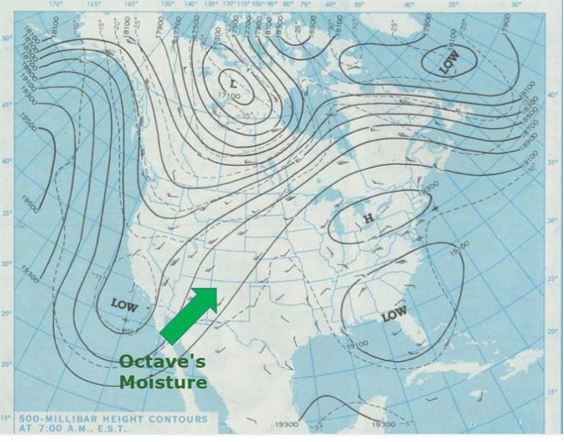
A 500 millibar upper-level) chart valid 7 AM September 29, 1983, shows an upper-level low west of California steering moisture from Tropical Storm Octave into the southwestern U.S. Credit – NOAA Central Library-Daily Weather Maps.
In this case, Octave was a weakening tropical storm off the coast of Mexico, but there was an unusual area of low pressure aloft, off the southern coast of California. The upper-level low steered Octave’s moisture right into Arizona and parts of New Mexico. This “funneling” effect kept streams of tropical moisture flowing into areas that were already vulnerable to flooding for days.


