
Overview
Hawaii sits in the middle of the Pacific Ocean and one would think that it would be a magnet for hurricanes. In fact, it’s very rare that a hurricane makes a direct landfall . There were reports that in 1843, a hurricane had some impact of Hawaii but details of the event are sketchy. In 1871, a major hurricane made landfall on the northern section of the Big Island but the area was sparsely populated. In 1959 Hurricane Dot produced considerable damage to Oahu and Kauai. Since most Hawaii is above 20 degrees north latitude, the ocean temperatures are below what would sustain a hurricane. Also cool low pressure troughs can come that far south.
All of that seems to be changing in recent times, a topic for another article but this season we have already had Hurricane Lala that missed landfall in Hawaii but it produced heavy rain. This week we have two major hurricanes in the central Pacific (Lowell is a Category 5) but both will miss landfall on the Hawaiian Islands.
The topic of this piece is about a major hurricane that made landfall on the island of Kauai thirty four years ago and it inflicted major damage and killed seven people. There was a strong El Nino that year and an even stronger one now, by the way.
Introduction
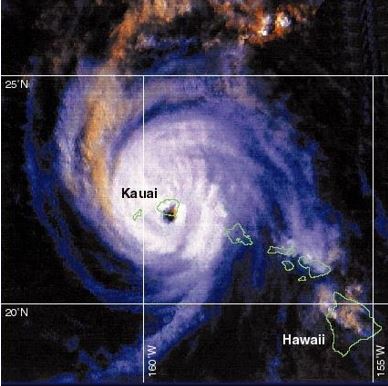
In Hawaiian, the name Iniki means “strong and piercing wind”. In September of 1992, Hurricane Iniki lived up to its name and more at it struck the Hawaiian Island of Kauai as a Category 4 storm on the 11th. The damage was extensive and basic services were cut off for months in some locations. On September 12th, Kauai residents were in store for a large and arduous task of reconstruction.
A Long And Uneventful Journey
Hurricane Iniki’s origin goes back to August 18, 1992, when a tropical wave moved off the coast of Africa. Atmospheric conditions in the Atlantic were not conducive to development so the wave moved westward until it entered the Caribbean. Because of a strong El Niño, upper-level winds made it impossible for development so the wave passed over Central America on August 28th and into the eastern Pacific.
In Hawaiian, the name Iniki means “strong and piercing wind”. In September of 1992, Hurricane Iniki lived up to its name and more at it struck the Hawaiian Island of Kauai as a Category 4 storm on the 11th. The damage was extensive and basic services were cut off for months in some locations. On September 12th, Kauai residents were in store for a large and arduous task of reconstruction.
Sudden Changes
Hurricane Iniki’s origin goes back to August 18, 1992, when a tropical wave moved off the coast of Africa. Atmospheric conditions in the Atlantic were not conducive to development so the wave moved westward until it entered the Caribbean. Because of a strong El Niño, upper-level winds made it impossible for development so the wave passed over Central America on August 28th and into the eastern Pacific.
There were significant changes going on aloft, however, and that would change the ultimate fate of Iniki.
The high-pressure ridge that was steering Iniki westward was beginning to break down. To the north, a strong upper-level trough was developing. By early September 10th, most computer models were indicating that Iniki would take a turn to the north-northwest once it passed the longitude of Hawaii but Iniki would still miss the islands to the west. Some model “outliers’ were bringing Iniki close to the islands but they were originally dismissed.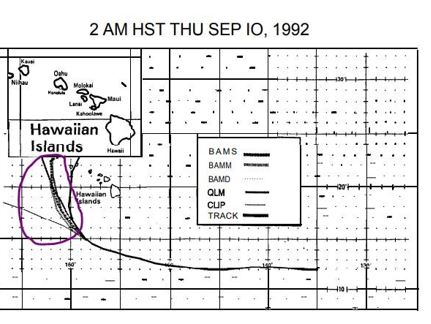
This map from September 10, 1992, shows various computer models with the forecast path of Hurricane Iniki. Map Credit-NationalWeather Service.
In the late afternoon of September 10th, Iniki took a dangerous turn toward the westernmost Hawaiian Islands and it strengthened rapidly. Iniki was being influenced by the strengthening of the upper-level trough. I was an On-Camera Meteorologist at the Weather Channel where we were following the progress of the storm closely.
Our chief hurricane forecaster, John Hope, indicated to us that it would be extremely rare for a “major” hurricane to strike the Hawaiian islands. Most hurricanes that approach Hawaii to come from the east or southeast and they weaken over cooler water before arriving. About only way that you could get an intense hurricane was for one to be farther south in more tropical waters and for it to be pulled rapidly northward toward the islands. That was EXACTLY what we what we were looking at!
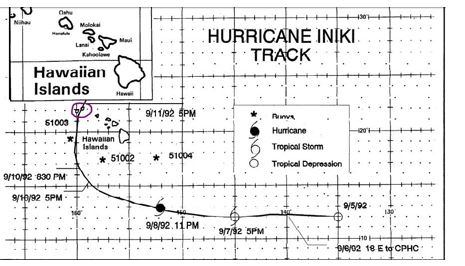
This map indicated daily position and track of Hurricane Iniki leading to landfall on Kauai on September 11, 1992. Map Credit-NWS.
Preparations
The residents of Kauai didn’t have too much lead time to prepare for Iniki but a solid preparation scheme was in place so things did go pretty smoothly once there was good evidence that parts of the Hawaiian islands were in harm’s way.
Here is an overview of preparations that were discussed in a publication by the National Weather Service:
By 8:30 p.m. HST, Hurricane Iniki turned to a more northerly track and the hurricane watch for Kauai and Niihau was upgraded to a hurricane warning. The eye of Iniki was expected to cross Kauai late on the afternoon of September 11, 1992. In addition, a tropical storm warning was issued for Oahu and a tropical storm watch were issued for Maui County (including the islands of Maui, Molokai, and Lanai). By 11 p.m. HST, the tropical storm warning for Oahu was upgraded to a hurricane warning.
By 8 a.m. on September 11, 1992, when the storm center was about 180 miles south of Kauai, Iniki had reached its peak intensity and was aimed directly at Kauai. A slight turn to the northeast, detected by radar for a few hours during the early morning hours, proved only to be temporary. By 1 p.m. HST on that day, the tropical storm watch for Maui was upgraded to a tropical storm warning. At 3 p.m. HST, the eye of Iniki was just south of Kauai and its forward speed had accelerated to 30 MPH. The eye crossed the western half of the island between 3:20 p.m. and 4 p.m. HST passing again over the water about 4:10 p.m.
Amazing – Don’t forget that this was before the internet!
None of Honolulu’s three affiliate television stations employs a meteorologist. One station has a full-length weather report given by a “weather specialist.” He provided full coverage during the storm build up. The other stations rely on an anchorperson to read the weather forecast. Station managers implied that the hiring of a full-time meteorologist would not be cost-effective considering that the weather is relatively stable. When the storm became the major news item, these stations used in-house reporters for coverage. Again, the telephone was the major vehicle for keeping informed of CPHC issuances and information.
When it became obvious that Iniki would hit Hawaii, the media, especially that on Oahu and Kauai, turned its full attention to the storm. In response to early statements from the NWS, the radio and television alerts were being given on Wednesday evening, 48 hours before the storm hit. On Thursday evening, when the western islands were placed under a hurricane watch, some of these stations began 24-hour coverage dedicated solely to the storm.
When the (civil defense) sirens were sounded on Friday morning, the radio stations, using NWS statements and direct telephone contact with NWS staff, provided a steady stream of information by which the public was alerted to the location, movement, and intensity of the storm. The media also disseminated safety information from the state and local CD authorities.
The public, for the most part, heeded the warnings, stayed off the roadways. Many went to various shelters around the island. Their response was certainly responsible for the overall low death toll.
The Wrath Of Iniki On Kauai
Hurricane Iniki made landfall on the western side of Kauai during the late afternoon of September 11, 1992, as a Category 4 hurricane with maximum sustained winds of 145 mph. There was widespread wind damage all over the island and some locations saw even more damage with a storm surge of 18 feet, Fortunately, Iniki was moving so quickly that rainfall totals were kept to a minimum.
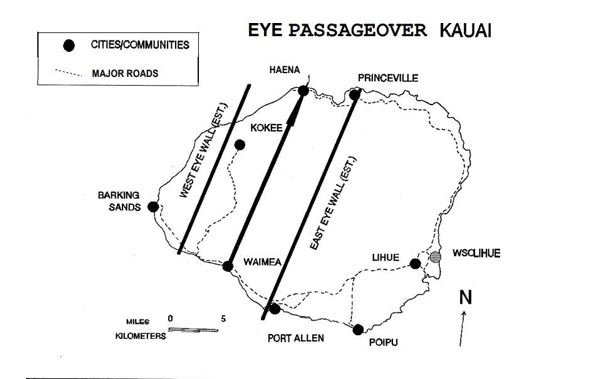
This map shows the path of Hurricane Iniki over the island of Kauai on September 11, 1992. Map Credit-National Weather Service,
In an article titled The Impact of Hurricane Iniki On The Life Of An Island And Its People, Steven R. Lee describes the horrific storm :
“The house is eerily quiet except for the slowly rising wail of the wind the minutes pass ever so slowly and the wind now begins to release its strength against the house itself hitting against it like a child stomps the ground in frustration now the ceiling creaks and the walls begin to rock the house begins to shake at rst just a vibration then a shudder and then nally with the feeling of a swelling force about to burst the windows there is a growing feeling of uncertainty will the house stand or will our shelter be ripped apart and will we be sucked out into the dark wet howling wind.”
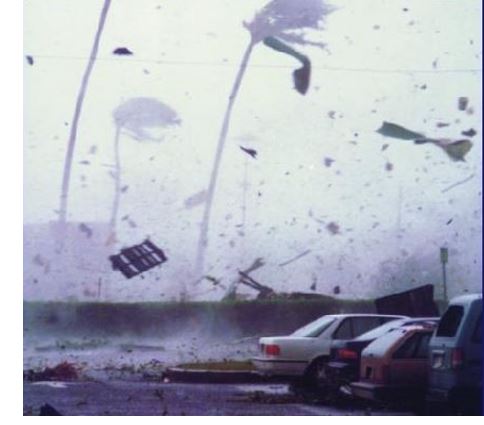
This photo shows flying debris and tree damage inflicted by Hurricane Iniki on the Island of Kauai on September 11, 1992. Photo-Public Domain.
“The roads are all empty save the cars of those foolhardy enough to ignore the civil defense officials all but emergency services have been asked to stay off the streets the unthinkable was about to happen the second of two major hurricanes was about to make a direct hit on Kauai.
Iniki’s Impacts
From Steven Lee : “When the dust settled nearly 10 of the island homes were destroyed and another 30-40 percent were left with major structural damage fewer than 10 were spared entirely thousands of utility poles were snapped like toothpicks broken off at the ground roads and highways were blocked by the litter of the downed poles and power was lost to the entire island water also was cut off to virtually all areas and what water was left was usually contaminated telephone service was eliminated with a few inexplicable exceptional lines that remained connected to the mainland much of the outside world was in the dark about conditions on Kauai for several days until military relief flights began to touch down.”
Most of the island had less than six hours notice that this was no false alarm an organized panic followed as thousands of tourists tried to leave the island and tens of thousands of residents tried to stock up on essentials for hurricane survival As the winds begin to shake the house we retreat to the safety of our little closet to await the anticipated eight-hour siege of Hurricane Iniki.”
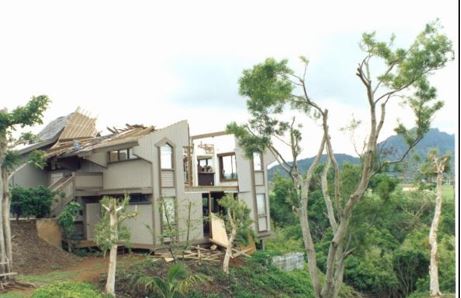
This photo shows one of the 1,500 homes damaged by Hurricane Iniki on Kauai on September 11, 1992. Photo Credit-Wikimedia Commons-Public Domain
It was quite apparent that Kauai sustained considerable damage to the island’s electrical, water, and communication infrastructure.
In fact, that power, water, and telephone lines took from three to six months to be restored in many areas. Because the island relied so much on tourism about three-quarters of the jobs on the island, were damaged extensively, with only the Hilton Hotel remaining open.
Many people found themselves out of work, so when reconstruction efforts began about six weeks later, many able-bodied men and women took on jobs in the reconstruction effort.
Odds and Ends
The National Weather Service in Honolulu indicated that there was a favorable reaction to the warning and response
The public, along with state and local of cials, felt that the NWS had done a fine job on Hurricane Iniki with adequate lead time on the watches and warnings. Some quotes received:
“The system worked – they [NWS did the best they possibly could within their capabilities.” Malcolm Sussel, Director of Oahu Civil Defense.
Pretty good job – everything worked well – NWS helped make a critical decision.” Frank Fasi, Mayor of Honolulu.
“Best job in 15 years forecasting Hurricane In&i.” Tom Batey, Administrative Assistant to the Mayor of Kauai.
“Outstanding support – they INWSI did a 1st class job – the system worked ne – a model.” Donald Gransback, Chief, Training, Education of the State Of ce of the Director of Civil Defense.
“The advance warnings of the NWS, the preparations and broadcast instructions of Civil Defense, and other government agencies functioned well in this emergency, though later critiques are likely to show areas of improvement.” Editorial from the Honolulu Star-Bulletin.
Although Oahu didn’t take a direct hit, there were some impacts.
Iniki produced tides up to 3 feet above normal on Oahu. Prolonged periods of high waves severely eroded and damaged the southwestern coast with the areas most affected being Barbers Point and through Ka’ena. The Waiʻanae coastline experienced the most damage, with waves and storm surge ooding the second oor of beachside apartments. Overall, Hurricane Iniki caused several million dollars in property damage and two deaths on Oahu.
At the time, scenes from the movie “Jurassic Park” were being lmed on Kauai. Director Steven Spielberg was surprised by the storm. A good number of sets that were constructed for the movie were destroyed. A couple of aftermath scenes were included in the movie.
As Iniki roared through, a number of chicken coops were ripped apart and several hundred chickens. mainly roosters escaped, Ths resulted in a large crossbreeding of the Red Junglefowl, which arrived during Polynesian migration more than 7,000 years ago and common domestic chickens imported from the continental United States. These feral chickens are seen all across the island today.
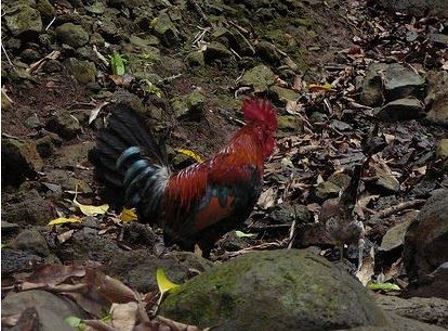
Feral chickens, like the one in this photo, are seen all over the island of Kauai since Hurricane Iniki struck in September of 1992. Photo Credit-Pinterest.
All told, there were seven deaths attributed to Iniki and over 1,000 injured. The entire population of Kauai suffered at least some property damage. Around 1,500 homes were totally destroyed and a third of the island’s population were left homeless. Property damage alone totaled 1.8 billion dollars (4.3 billion 2026 dollars) and total damage exceeded 3 billion dollars (about 7 billion 2026 dollars) !


