
Introduction
The Atlantic Hurricane Season can produce a variety of tropical entities with a wide variety of impacts. You don’t need hurricane to produce catastrophic results with substantial loss of life. Wind damage can be inflicted by hurricanes but catastrophic damage can be inflicted by tropical storms or even tropical depressions. One seemingly innocuous tropical storm did produce this kind of damage over parts of Texas 48 years ago !
Tropical Storm Amelia
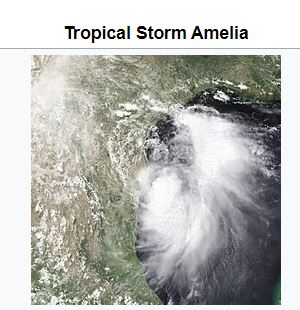
Amelia was a weak tropical storm that ended up being the second-wettest tropical cyclone on record in the continental U.S. Amelia stated out as a tropical wave that came off of the African Coast and moved westward through the Atlantic and on to the Gulf of Mexico. It became a tropical depression in the Gulf and the forecast was for it to remain a depression as it moved toward the southern Texas Coast. The tropical depression did get a bit stronger before landfall and it was named Tropical Storm Amelia before making landfall at Corpus Christi , Texas, on July 31st. Amelia weakened as it drifted inland toward San Antonio on August 1st where the circulation dissipated.
The event wasn’t over, however. Not by a long shot !
Extreme Impacts From Amelia’s Remnants
There were Tropical Storm Warnings issued for the south coast of Texas as Amelia arrived. Wind impacts were rather modest with gusts to 38 mph at Brownsville to 58 mph a Corpus Christi. Inland areas were under drought conditions and the general feeling was that any rain from Amelia would be beneficial. That wasn’t the case because the drought conditions were so extreme that any rain would just run off rather than seeping down into the soil.
The worst impacts from Amelia occurred after it dissipated. There were record rainfall totals. Several rivers flooded around the Texas Hill Country and northern Texas and the damage was severe!
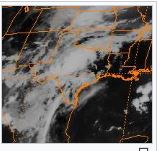
A satellite image showing the remnants of Tropical Storm Amelia which produced catastrophic flooding over parts of Texas in 1978. Image Credit – NASA.
President Jimmy Carter issued disaster declarations for six counties so that they could apply for government aid.
Additional aid was brought in from states all around the nation. Overall, Amelia caused 33 fatalities with an estimated $110 million in damages ($565 million 2026 dollars) , . Governor Dolph Briscoe called one of the worst floods in the history of the state.
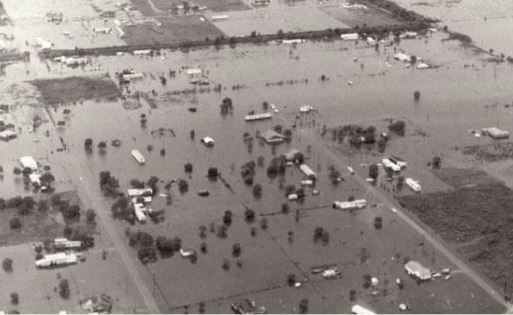
Remnants of Tropical Storm Amelia flooded many inland areas of Texas in August 1978. Photo Credit – Texas Department Of Insurance
In northern Texas, the town of Albany suffered extensive damage when their drainage system and Hubbard Creek flooded. Twenty five to thirty houses we totally destroyed and hundred of businesses were damaged as 80 percent of the own was inundated! A bridge on U.S. Route 180 buckled so no o could enter or leave the town. Albany recorded 32 inches of rain while there were unconfirmed reports over45 inches !
Initially, nine deaths were reported and twelve missing. Some of the missing were buried too deep in mud to be saved.
The torrents were also responsible for carving a 50 feet deep hole in an earthen dam at nearby Lake Throckmorton, but the water from the dam was safely taken up by a nearby creek. The town of Throckmorton was completely evacuated and, like Albany, had its fresh water supply was contaminated.
Farther north,, the Brazos River also flooded. The Brazos overflowing, in addition to the flooding of the nearby Salt Creek, resulted in the west side of Graham — the county seat of Young County where flood victims from Eliasville and South Bend had taken shelter — becoming flooded over to within blocks of the Young County Courthouse. Later, the flood waters were reported to have entered the basement of the courthouse. Effects from the flooding in Graham ranged from 150 houses and 40–50 businesses being inundated with the loss of water and electrical utilities. No fatalities were reported, however, due to the water levels rising gradually, leaving time for residents to evacuate.
The hardest hit area from this massive flooding event was farther south along the Guadalupe River Basin and its feeders! Uvalde was flooded up to a block away from the courthouse. The Guadalupe River became heavily flooded, rising 10 feet in just one hour. The rapid rise covered a bridge on U.S. Route 281 40 miles north of San Antonio and prompted evacuations in a 20 – mile area near the flood plains. The overflowing river was responsible for ten total deaths in Kendall and Kerr Counties and submerging Comfort under seven feet of water, killing four people there. After receding, the Guadalupe steadily became full again.
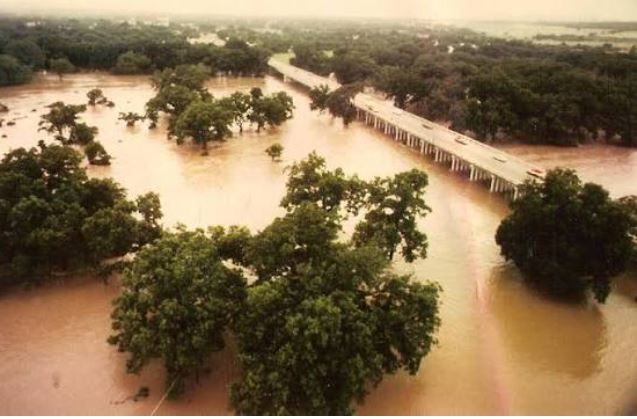
Extreme flooding along the Guadalupe River inundated the town of Comfort, Texas, in August 1978, Photo Credit- My SA.
The most significant impacts were in Bandera County. This was caused by the flooding of the Medina River where the heavy rainfall totals produced a 500-year flood! The Bandera and Medina Medina turned into a 50 feet wall of water, which destroyed several of the trees along the river in addition to causing various items to block the roads.
Two people were witnessed clinging to a roof that was swept into the Medina. Another100 people were cut off due to the river flood. 10–15 houses were washed away and the courthouse became an evacuation center.
At the riverfront Camp Bandina, eight people were reported killed while 100 children escaped by staying at the church camp nearby. The Peaceful Valley Ranch was nearly decimated, with only the building foundations still remaining. Six people were killed by the floods while sleeping while 20 guests and staff rode out the storm by clinging to trees and roofs for six hours
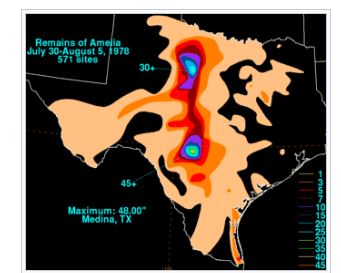 A map showing Texas rainfall totals from the remnants of Tropical Storm Amelia in August 1978 , Map Credit -NOAA.
Notable Statistics
The Medina River crested at 45 feet, breaking the record for flood stage reached on the river that was set in 1919 at 43 feet as well as breaking the record for water flow or the rate in which water flows down the river, at 79 billion gallons per day. The Brazos River had its highest flooding since 1957.Records were also set for flowing on the Guadalupe, which flowed at 149 billion gallons a day, more than twice the previous record and nearly 1500 times its usual rate of 100 million gallons per day!
The storm total of 48 inches at Medina was the wettest known storm total rainfall amount for both the state of Texas and any tropical cyclone impacting the continental U.S. until Hurricane Harvey in 2017. A 12-hour total of 26 inches of rain at Abilene was an extreme example of the precipitation.
In addition, with genesis occurring at a longitude of 97.0°W Amelia holds the record for the westernmost formation of a tropical cyclone in the North Atlantic hurricane database (since 1851). The town of Albany recorded 32 inches of rain and there were unconfirmed reports of 40-inch totals,


