
Preface
There have been recordings of late snowfalls in the northeastern U.S. over time. In fact, there was snow recorded recently, over the weekend of May 30/31 2026. Up to four inches of snow fell in parts of northern New England at elevations over 4,o00 feet and there as even a light dusting in the lower elevations. Late snowfalls normally occur over a day or two before temperatures rebound quickly.
That was not the case back in 1816 as spring turned to summer. There were odd colors across the sky. Temperatures were often well below seasonal averages, with snow and frequent frosts. The negative impacts, especially regarding agriculture, were devastating.
The causes of this extreme anomaly and the impacts are the subject of this story.
We go back over 200 years ago to 1815 when a catastrophic eruption of a volcano altered weather patterns worldwide.
Back then, most residents of the U.S. were farmers. The Midwest and West were scarcely settled, so most of the population lived east of the Appalachians. In the Northeast, farmers planted and harvested their own crops for food, either for them and their their livestock. They relied on this yearly cycle for their livelihood.
A Massive Volcanic Eruption
In the spring of 1815, the Tambora volcano, on the northern shore of Indonesia’s Sambawa Island became much more active. On April 10, 1815, there was a massive eruption. The incredible sound of this explosion was heard over 1,000 miles away, and it created a tsunami that killed over 10,000 people around the Indian Ocean. Tambora spewed an overwhelming amount debris and gas into the atmosphere, along with nearly 40 square miles of volcanic ash!
The volcanic ash and, to a greater extent, sulfuric acid, blocked incoming solar radiation, resulting in a much cooler planet. The cold spells of 1816, lasting through the winter of 1817, were not confined to the U.S. It also turned very cold in western Europe and parts of Asia, leading to crop failures worldwide.
April to September 1816
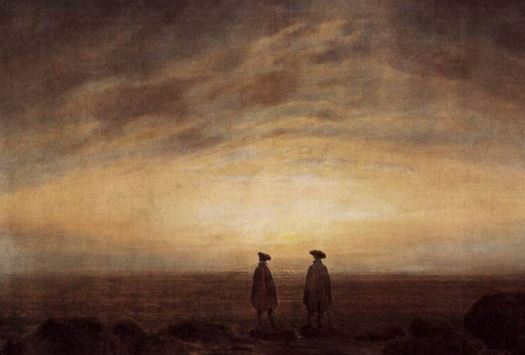
After a relatively mild winter, April arrived in the Northeast with plenty of showers and occasional warm spells, but there certainly weren’t any hints of what was to come soon. Farmers planted their crops, the sheep were shorn and all seemed well. There were few ominous signs, however, that something was wrong. As residents of the Northeast looked skyward, there were mixed colors of red, yellow and brown tints. Artists from many parts of the world would paint the sky in these tones for a few years to some.
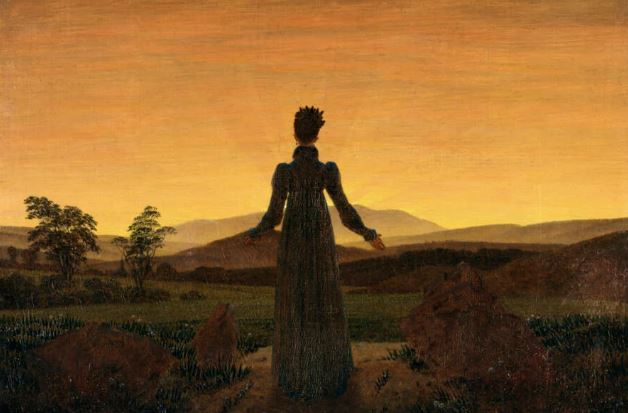
Paintings like this one from Caspar David Friedrich showing various colors of the daytime sky were common for a few years following the volcanic eruption of Tambora in 1815. Image- Public Domain,
Weather records indicate that the high temperature flirted with 80 degrees over southern New Hampshire on the last three days of the month.
The overall weather in May was quite cold for plants, vegetables, livestock and even humans. According to weather records, a powerful cold front swept through New England on May 2nd. The temperature plunged to below freezing that night across much of interior New England.
Several cold fronts, sweeping down from Canada, continued for the rest of the month. Throughout parts of Upstate New York and New England, the temperature only reached 70 degrees on a handful of days. There were many mornings with frost.
At times, ice was a half-inch thick on some rivers from northwest Pennsylvania through parts of upstate New York to New England, especially during the middle of the month. A few inches of snow also fell at that time, especially in higher elevations.
The anomalous cold continued into June. After a warm start, the temperature plunged rapidly on June 5 and snow began to fall. Much of southern New England and upstate New York had trace amounts, but higher elevations in interior sections of New England picked up 6 inches of snow. The snow often features a variety of colors.
Parts of Down East Maine recorded up to a foot of snow. Snowflakes fell on June 7 in Boston – their latest report of snow on record. The cold extended all the way down through the Mid-Atlantic States.
Higher elevations kept a snow cover and the temperatures remained in the 20s on some days. Cape May, New Jersey, recorded five consecutive mornings with frost during the middle of June. Frost also occurred down to Maryland and Virginia. After a brief warm spell, temperatures plunged again around the end of the month.
July featured various warm and cold spells temperatures were generally below average for most of the month. It was particularly cold from the 4th to the 8th, and on the 4th, cold temperatures reached all the way down to the South. On that day, the temperature dipped into the upper 40s in Savannah, Georgia. On July 8, widespread frost was reported from Maine to Virginia. Albany, New York, reported a hard frost on several mornings !
Cold air, sweeping down from Canada was dry. Despite the bit of snow, there was very little rain after April, and the Northeast region was in a significant drought by July, just to make matters far worse.
August was warmer for a while and many farmers in the Northeast, attempting to salvage what they could from the season, tried to plant some crops. All hopes were swept away by the 20th, however, when another cold front pushed through, followed by a killing frost. September began quite cold. This period of 1816 was often referred to as “A Year Without A Summer “. The period of below average temperatures extended into 1817.
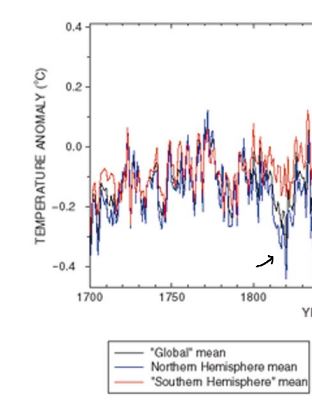 Comparison of reconstructed annual-mean temperature trends for Southern Hemisphere, Northern Hemisphere, and global mean. (note the greatest negative temperature anomaly affected by Tambura’s eruption and aftermath). Additional data are available online at http://www.ngdc.noaa.gov/paleo/ei/eipreconsa.html.
Impacts Of The Cold Summer
- Frost and freezing temperatures decimated the fruit crop across the Northeast.
- Corn, which was a staple (for humans and animals) across the Northeast, was completely destroyed.
- Vegetables, such as beans, cucumbers, and tender vegetation, were mostly wiped out from New England down to New Jersey.
- Livestock, such as sheep, froze to death and others perished from starvation due to lack of feed.
- There was severe inflation at the market for everyday goods like potatoes and bread.
- Many farmers became sick and died from diseases or lack of food.
- Farmers in New England referred to the year as “eighteen hundred and starved to death.” All the way down to Virginia, the impacts were felt. Former President Thomas Jefferson lost about two-thirds of his crops and he went into debt.
A significant number of farmers in the Northeast, especially in New England, decided to move away and migrated westward. Many of them traveled west of the Appalachians and into the Midwest to establish new farms.
The global cooling caused by the nearly 40 square miles of volcanic ash led to worldwide crop failures produced a death toll exceeding 100,000.


