

It’s not unusual during the winter to see the intrusion of arctic air masses into the U.S and occasionally the cold fronts associated with these air masses can make it all the way down to Florida. In fact, this weekend will be very cold in the Deep South and snowflakes could fly all the way down to Georgia! A little over 50 years ago one of these events would be beyond extreme resulting in some all time record cold and snow for areas down to the lower latitudes !
During the time frame from late November of 1976 through mid-February of 1977, there were frequent arctic outbreaks across the eastern U.S. Many rivers were totally frozen at that time, including the Ohio, and there were all-time low-temperature records established that remain to this day. The coldest and most far-reaching outbreak occurred in January of 1977. The record freeze in Florida destroyed many fruit crops and snow actually fell in the southern part of the state.
During that time period, I was living in Arlington, Virginia, and I took a bus every workday into Washington, D.C. The bus route took us over the 14th Street Bridge where I could see a frozen Potomac River below. Many residents of D.C. laced up ice skates and proceeded on the river. Some brave souls even drove cars out on the frozen river, To the east, there was so much ice on the Chesapeake Bay that icebreakers were brought in to keep shipping lanes open.
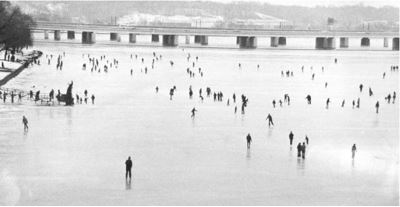
A photo showing people ice skating on a frozen Potomac River near the 14th Street Bridge at Washington, D.C. in January 1977. Credit- Washington Weather.
With the polar vortex stationed over Quebec and a blocking high-pressure system over Greenland and eastern Canada. There was also a large upper-level ridge over Alaska, As a result, extremely cold air was forced southward during the third week of January.

The above photo shows large amounts of ice on the Chesapeake Bay in January of 1977. Photo Credit-NOAA.
On Tuesday, January 18th, an arctic cold front pushed down through Florida and into Cuba. Temperatures tumbled in Florida behind the front. Overnight, there was snow reported in northern and central Florida.

An upper-level (500 millibar) chart for January 19, 1977 (jet stream added). Credit – NOAA Central Library.
As dawn approached, the landscape was white in Orlando and Tampa. I spoke with a friend who was working at Walt Disney World during that time and he told me about a half-inch of snow fell there Tampa received about a quarter of an inch and there were two inches on the ground just east of Tampa.
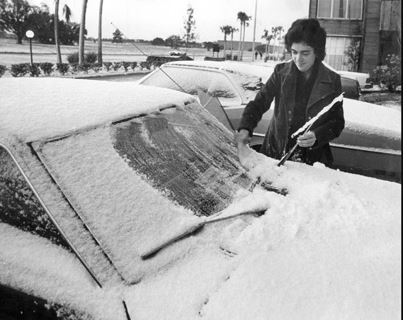
A woman brushes snow off of her car near Tampa, Florida,on January 19, 1977 . Photo Credit- Tampa Bay Times.
Farthest South Snow On Record For The U.S.
On the morning Wednesday, January 19, 1977, many residents of South Florida witnessed something that was unprecedented. West Palm Beach reported their first snowfall on record and occasional snow showers continued for about two hours.
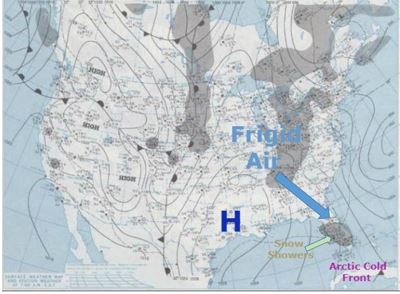
A surface weather map for January 19, 1977 (jet stream added). Credit – NOAA Central Library.
LaBelle, Florida, also reported snow flurries in their cooperative observation report.
To the south, rain began to mix with snow and the precipitation changed to snow flurries. Snow flurries fell across parts of Broward and Miami-Dade counties between 8 a.m. and 9:30 a.m.
Cooperative observing stations in Hollywood and Royal Palm Ranger Station in far southern Miami-Dade County reported a trace of snow. Rain changed to snow flurries at Homestead and that remains the farthest south in the United States that snow has been observed.
A mix of rain and snow showers also fell at Freeport in the Bahamas and that is the first and only time that snow has been observed there. The temperature fell to 39 degrees but the west end of Grand Bahama Island dropped to 35 degrees. According to an article in bahamaslocal.com Geoffrey Greene, a senior officer at the Meteorological Office, said the Grand Bahama snow was an extremely rare, maybe once in a lifetime event. Indeed that was the first, and only, time that snow was reported in the Bahamas.
Greene said the chances of snow getting any farther south were unimaginable. “There is just too much warm air for any cold system to compete with”.
An Aerographers Mate, on an ocean vessel called the “Evergreen”, which was traveling through the central Bahamian Islands, said that the temperature fell to 34 degrees with snow showers and wind gusts to 40 mph from the Northwest.

Snowflakes fell as the day began at West Palm Beach, Florida, on January 19, 1977. Photo Credit- Palm Beach Post.
The South Florida Sun-Sentinel spoke with several residents of the area to chronicle their recollections.
“I am a native Floridian who had never seen snow until that day. I was a junior at Msgr. Edward Pace High School and I vividly remember being in drama class when we learned it was snowing. We ran out and looked up in amazement at the akes falling and just as quickly melting away.” – Susan R. Miller-Pembroke Pines.
“I was 13 years old and an eighth-grader at Plantation Middle School. I can remember being in class and a student ran in the class and shouted, ‘It’s snowing!’ The entire class went crazy, the teacher lost control as everyone ran outside to see it snowing. I remember seeing a small number of snowflakes falling from the sky, but being a Floridian and never experiencing this before, it was really cool.” – Donald Kirby, Miami
“I was 19 years old driving in my ’69 Volkswagen convertible on Hallandale Beach Boulevard when suddenly I observed dust particles falling all over my windshield. I was completely confused as I knew it couldn’t be ashes from the Everglades because it was too cold for there to be a fire, and that’s when it dawned on me, it wasn’t dust, it had to be some kind of snow, then I realized it was snow flurries! I slammed on my brakes in the middle of the road on Hallandale Beach Boulevard and jumped out of my car. I put my face to the sky, held out my arms, and whirled around in something completely foreign to me, light snow. Then other people got out of their cars in amazement, and we looked at each other as if we were experiencing some kind of miracle. Born and raised in Florida, I had never seen snow, and I will never forget that day as long as I live.” – Fleda Silverberg, Plantation.
A number of traffic accidents occurred across Florida due to snow and ice. There was a ten-car pileup in Tampa, and another accident killed a man near Auburndale when his car skidded in snow and crashed into a truck.
The high temperature that day remained in the 40s in Miami and the temperature tumbled quickly after sunset. The mercury fell below freezing (31 degrees) at Miami International Airport on the morning of January 20th.
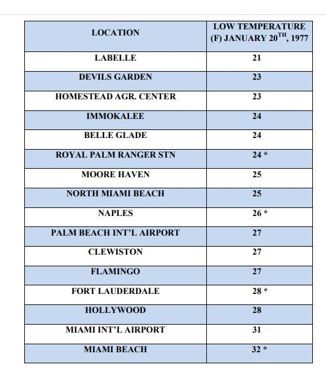
Low temperatures on the morning of January 20th, 1977 in South Florida. Credit – NWS. * indicates all-time record low.
Meteorological Conditions
With a jet stream so far south, arctic air rushed through Florida and even into Cuba. Havana, Cuba, recorded a low temperature of 43 degrees during this event.
With cold air and a deep trough aloft, moisture was squeezed out into the atmosphere and that resulted in the snow showers across South Florida and parts of the Bahamas. Only trace amounts of snow were recorded in South Florida, but as mentioned earlier, the ground was white along the I4 corridor from Orlando to Tampa. many schools and businesses were shut down as a result.
Areas just east of Tampa picked up from one to two inches of snow early on January 19th. The snow total there was enhanced by the arctic air passing over the warmer waters of the Gulf of Mexico (Gulf-Effect snow).
Costly Impacts
Despite the euphoria that much of the population felt from actually seeing snow in the air severely cold temperatures continued for a few days across Florida. There was extensive damage to agriculture in the state. The USDA reported crop losses of 35% to citrus and at least 95% to vegetables, 50% to commercial pasturelands and 40% to sugar cane.
Total crop damage was estimated to be around $350 million dollars (1.8 billion 2026 dollars) and about 30% of that was in Dade County. Overall, the cold wave caused up to $2 billion dollars (10.6 billion 2026 dollars) in damage. The January 1977 freeze, combined with an 1983 freeze forced agriculture interests to move central Florida’s citrus crop farther south.

