
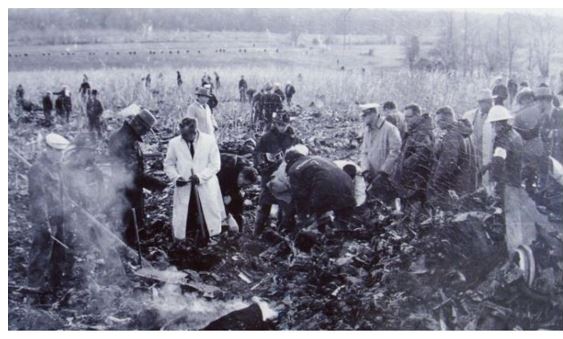
Over the past decades, there has been a dramatic decline in airline accidents and passenger deaths. This piece will take us back to December 8,1963 when Pan Am Flight 214 crashed near Elkton, Maryland after being struck by lightning causing the fuel inside the reserves to explode and catch fire. The plan crashed and 81 lives were taken.
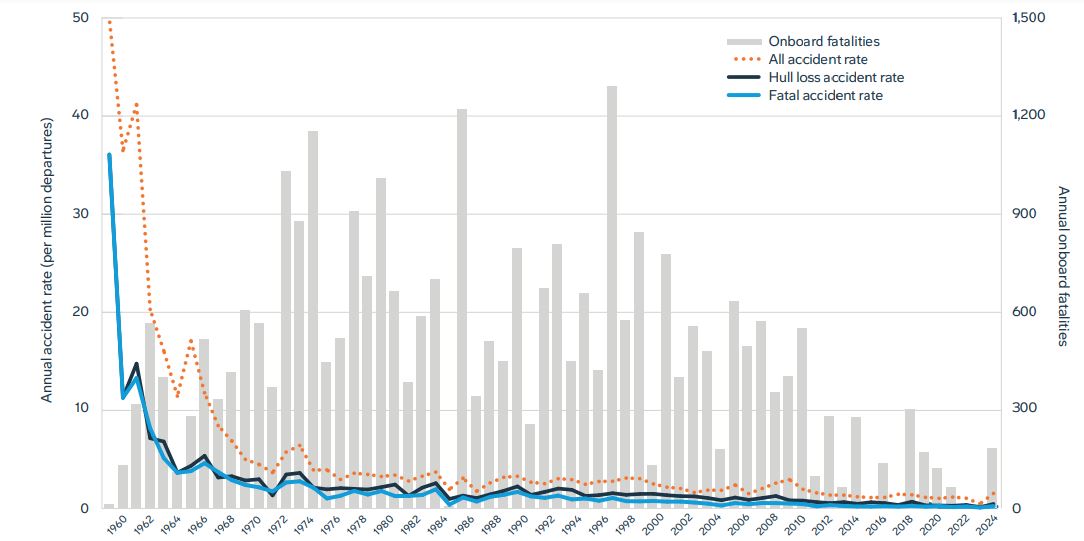
A graph showing a major decline in airline accidents and fatalities from 1960 to 2024. U.S. DOT stats.
Since than a vast number of advances which allows aircraft to experience lightning strikes without any incidents.
The Ill-Fated Flight
“MAYDAY MAYDAY MAYDAY” Clipper 214 out of control. Here we go.” These were the final words of a “resigned” pilot of Pan Am Flight 214 on the evening of December 8, 1963.
In his 22 years with Pan Am, Captain George F. Knuth had 17,049 hours total flying, with 2,890 hours flying a Boeing 707 but there was nothing he could do after a bolt of lightning struck the plane and triggered an explosion resulting in catastrophic damage. The event was a tragedy indeed but there were more “tragedies” exposed in the days and months following the crash.
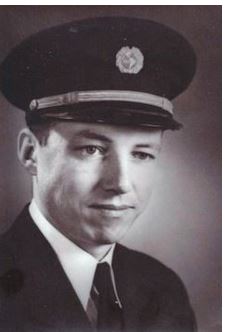
A photo of Captain George F. Knuth, the pilot of Pam Am Fight 214 that crashed near Elkton, Maryland, on December 8, 1963. he was 45 years old. Photo Credit- Family Search.
Pan Am Flight 214 departed Philadelphia on the morning of December 8, 1963. After a short journey, it made a quick scheduled stop at Baltimore, Maryland and went on to land at San Juan Puerto Rico.
Before leaving on a return flight to Philadelphia, Captain Knuth was given a weather briefing. Rain and thunderstorms were possible in the Mid-Atlantic area with a frontal boundary passing through in the evening.
At 4:10 p.m. Pan Am Flight 214 departed San Juan Puerto Rico and landed in Baltimore at 7:35 p.m. 69 passengers disembarked the plane. Captain Knuth received a quick weather briefing. A front would be moving through Philadelphia during the next hour and there would be rain and possibly thunderstorms in the area.
At 8:24 p.m. the plane left Baltimore for (what was supposed to be) a short flight to Philadelphia. There were 73 passengers and 8 crewmembers on board.
At 8:42 p.m. The crew was advised to go into a holding pattern while it was over Delaware due to rain and gusty winds.
At 8:50 p.m. The crew was advised to hold their approach until 9:10 at an altitude of 5,000 feet. and that was acknowledged (“Roger, no hurry,”).
At 8:58 p.m. An ill-fated message from the captain “MAYDAY MAYDAY MAYDAY. Clipper 214 out of control. Here we go.”
Pan Am Flight 214 crashed at 8:59 p.m. about 2 miles east of Elkton, Maryland. Witnesses around the accident area described the weather as cloudy, with light rain falling, and lightning.
According to a Civil Aeronautics Board Aircraft Accident Report, there were many witnesses to the crash.
Of the 140 ground witnesses interviewed, 99 reported sighting an aircraft or flaming object in the sky. Seventy-two of these witnesses saw lightning and seven stated they saw the lightning strike the aircraft. Three other persons saw a ball of fire appear at the fork or one end of the lightning stroke. Seventy-two witnesses indicated that the ball of fire appeared concurrent with or immediately following the lightning stroke. Twenty-seven saw re preceded by lightning with a very short interval before the re was visible. Twenty-three witnesses observed an explosion in connection with the aircraft in flight after re was observed. Thirty-eight mentioned an explosion at impact.
Additionally, 28 witnesses saw objects fall from the aircraft in flight and 48 described portions of the aircraft they observed to be in flames.
The crash site, centered in a field of the Berry Family Farm, covered a four-mile area. Debris, pieces of the plane and oil were scattered through the field, in trees and on cars and houses.
A staff member of the Cecil County, Maryland, historical society, Jo Ann Gardner, told me that she was too young to remember but her brother was in Newark, Delawa,e and he felt the ground shake at the time of the crash.
It seems so unreal now because there are so many planes struck by lightning but the CAB determined that the probable cause of this accident was lightning-induced ignition of the fuel/air mixture in the No. 1 reserve fuel tank with resultant explosive disintegration of the left outer wing and loss of control.

Photo of the Boeing 707 (named the Clipper Tradewind) that was delivered to Pan Am On August 8, 1958. This is the plane that crashed. Credit-Public Domain.
Leon H. Tanguay, director of the CAB Bureau of Safety, sent a letter to the FAA recommending several safety modifications as part of future aircraft design. One modification related specifically to volatile fuel vapors that can form inside partially empty fuel tanks, which may be ignited by various potential ignition sources and cause an explosion. Tanguay’s letter suggested reducing the volatility of the fuel/air gas mixture by introducing an inert gas or by using air circulation.
The bodies of all persons aboard the aircraft were recovered and identified. Toxicological examination of the flight crew showed no evidence of alcohol or elevated carbon monoxide levels. Carbon monoxide tests of the victims also indicated no elevated levels. The flight crew was physically qualified for flight according to FAA and Pan American records.
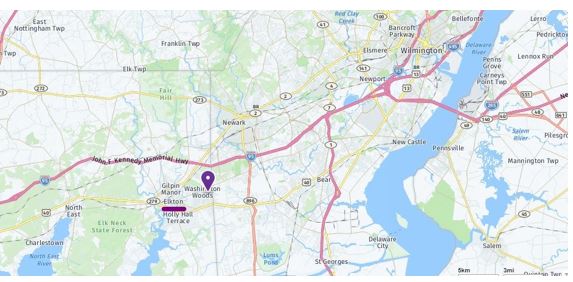
A map of the Elkton, Maryland area. The marker indicates Delancy Road near the crash site (around the Maryland-Delaware border). Credit- Yahoo Maps.
Another Type Of Tragedy
I usually detail weather conditions that were present at the time of events but there is a more important issue.
As for the weather, I will only say that there was a frontal boundary in the area where the aircraft crashed and a cold rain was falling. There were also exaggerated atmospheric dynamics with the weather system that resulted in thunderstorms, along with the rain.
Returning from my digression, remember that this was 1963. When fatal accidents occurred there were no procedures in place for contacting next of kin.
Another factor to keep in mind was the overall mental state of the nation since this event took place a little more than two weeks after the assassination of President John F. Kennedy.
In this case, many family members heard about the crash from media sources such as radio and television or phone calls from friends or relatives that had heard about it.
An article from cecildaily.com (The Whig) told the stories of some of the victim’s family members. One son of a crash victim heard the news over the radio. “My dad’s brother came to the house and tried to comfort all of us. No one from the airline came to us or offered us assistance. We relied totally on friends and family.” “I had one English teacher who talked to me and tried to offer words of comfort, but there was no counseling for me or the other students in the school like there is now.”
News of the crash and the name of the pilot was broadcast on a local TV station. That is how the wife of the pilot (Elizabeth Knuth) heard about it while she was at a neighbor’s house. One of the other neighbors, a doctor, gave her a sedative and walked her back home. They then broke the news to the pilot’s 16-year-old daughter (Carol).
Members of the Airline Pilots Association then arrived overnight to guard the house against the press/
Carol remembers the lack of support systems to help her and the rest of her family cope.
“There was no one at school to help. I seem to remember something about the airlines sending people to our house to keep the press out. There were quite a few press people at our house because my father was the pilot. My older sister came home from college in Wisconsin. She helped my mother.”
In 1963, there were no grief counselors for relatives and loved ones of victims of catastrophic events, let alone school or workmates. Overall mental health wasn’t a priority in those days and many of the families never experienced closure.
The tragedy of the aftermath didn’t stop there. Remember the crash victim’s son that we talked about earlier. After returning to school, he received a sympathy note from a classmate. The note indicated that she was thinking about him and his family in their time of grief.
One of his relatives was a reporter at a local newspaper and wanted to write a story about the sympathy note after interviewing him and the classmate. The classmate was African-American.
Sadly, following the publication of the article, the phone of the crash victim’s family kept ringing with hate calls, The son was criticized for having black friends and associating with black classmates.
A Time For Closure
I don’t think that families and friends of victims of these events could completely recover from the grief, questions and even guilt that are associated with this type of event. I have some good news to add to the story, however.
On December 8th, 2013, fifty years after the Pan Am 214 crash, family members were invited to a “remembrance ceremony” at the Cecil County Historical Association in Elkton, Maryland. The event was hosted by the Singerly Fire Company.
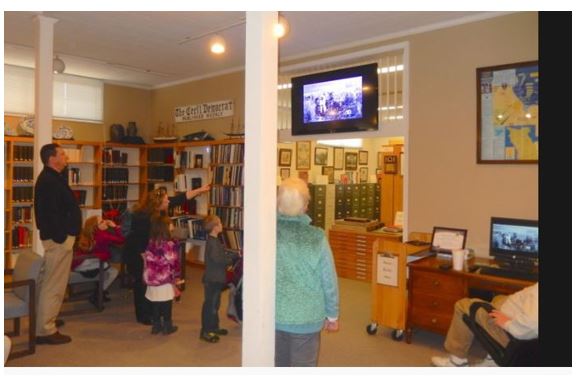
Photos show family members of Pan Am Flight 214 victims look over material related to the fatal crash. Photo Credit- Historical Society of Cecil County.
The family members were able to talk with each other, console each other (albeit fifty years later) and scan through materials related to the crash.
There was also a commemorative tribute at the site of the crash on Delancy Road.
There are folders of information dealing with this event for families or anyone from the general public to look over at the Historical Society of Cecil County.
Aftermath
We are now in an age when an airliner can survive a lightning strike. Lightning strikes will usually leave small burn marks or holes at the entry and exit point.
As a result of the crash of fight 214, the (FAA) ordered lightning discharge wicks (or static discharger) to be installed on all commercial jets flying inside U.S. airspace.
Lightning is able to move along the skin of the airplane without doing damage.
As for social issues, there has been much progress made over the past 55 years. Procedures for the notification of next of kin before the release of the victim’s names have been in place for a long time.
There has been signifcant progress regarding the mental health and mental well being for family members of mass casualty victims like this. Changes in attitudes toward race have also been made.
One could present a strong argument that much more needs to be resolved, however.
This article’s featured photo shows First Responders and other officials around the crash site of Pan Am 214 performing clean up duties and rescuing the remains of the 81 victims.
The wife of George Knuth Elizabeth (Betty) Knuth, who already had a medical degree at the time of her husband’s death passed away in 2016 at age 96. She was Assistant Dean of Students at Dowling College in Oakdale, NY until 1990.
Daughter Carol (Knuth) Sakoian was a Vice President of International Business Development at Scholastic Inc. in New York City.
Safety Advances – 1962-2025
Lightning is able to move along the skin of the airplane without doing damage. Here are some examples of the advances that have been made regarding lightning and commercial aircraft – (from AI)
- Faraday Cage Effect: Aircraft skins (metal or conductive mesh on composites) channel lightning current around the interior, protecting occupants and electronics.
- Strike Receptors & Diverters: Specific points (nose, wingtips, tail) intercept strikes, guiding current via bonding and grounding straps to safe exit points, often using diverter strips on composite parts.
- Shielded Wiring & Avionics: Sensitive wires are shielded, and components are protected in Faraday cages to prevent damage from voltage spikes.
- Fuel Tank Integrity: Critical designs ensure no arcing occurs near fuel, a primary safety concern.
- Predictive & Active Systems: Onboard sensors and AI predict strike risk, potentially adjusting the aircraft’s electrical charge to deter strikes before they happen.
- Advanced Materials: Additive manufacturing (3D printing) creates lightweight, customized shielding, while new coatings improve durability and repairability.
- AI-Driven Diagnostics: Embedded sensors detect strikes in real-time, enabling immediate, precise damage assessment and reducing inspection time, says a report from Global Market Insights.
- New Design Modeling (MIT): Physics-based tools predict lightning paths on unconventional designs (like blended wings) to optimize protection zones before construction.
- Real-Time Monitoring: Systems like UNIMET use data to issue alerts and define critical radii (e.g., 3 miles) for suspending ground operations.


